

 Quick read
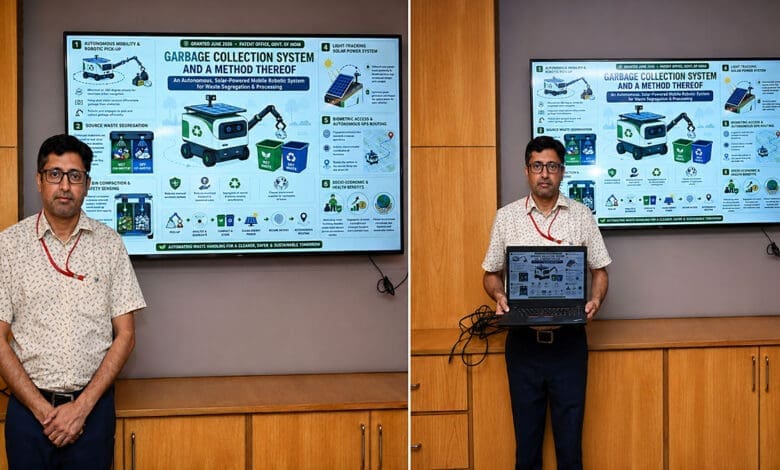
A team of researchers from Chandigarh University has developed and patented a solar-powered robotic garbage collection system that can automatically identify, collect, segregate, compress and transport waste without human intervention, offering a technology-driven solution to India’s growing municipal waste management challenges.
The invention, titled “Garbage Collection System and Method Thereof,” was granted a patent by the Patent Office, Government of India in June 2026. The innovation was developed by Prof (Dr) Nitin Sharma from the Department of Electronics and Communication Engineering (ECE), along with Dr Paras Chawla, former professor at CU’s ECE department and ECE students Hemant Kalia, Jayant Pathak, and Ritesh Sharma.
According to Prof Sharma, India’s rapid urbanisation, rising population and limited landfill space have made municipal solid waste management increasingly difficult. He said manual collection and segregation of mixed waste remains labour-intensive, time-consuming and poses health risks to sanitation workers, making source-level segregation essential for reducing transportation and treatment costs.
The patented robotic system has been designed to automate the entire process. Equipped with a robotic arm, vision sensor, capacitive sensor, GPS module, smoke sensor and Arduino-based control system, the machine can identify garbage, distinguish it from obstacles, determine whether the waste is wet or dry and deposit it into separate storage chambers.
The system moves on 360-degree wheels, allowing it to navigate independently in multiple directions. Once garbage is collected, built-in compressor units reduce the volume of both wet and dry waste, increasing storage capacity before the robot transports the waste to the nearest designated dumping site.
Powered entirely through solar energy, the robot features rooftop solar panels that continuously charge its battery. A light sensor automatically adjusts the angle of the panels toward sunlight to maximize energy generation, reducing dependence on external power sources.
The machine also incorporates safety and monitoring features, including pressure sensors that regulate the compression process, smoke sensors that detect fire hazards inside the storage chambers, GPS tracking for location monitoring and a fingerprint lock for secure system access.
Prof Sharma said the technology aims to eliminate human involvement in hazardous waste handling while improving the efficiency of waste collection, segregation and transportation through automation and renewable energy.
Congratulating the research team, Deepinder Singh Sandhu, Senior Managing Director of Chandigarh University, said the patent reflects the university’s strong research and innovation ecosystem focused on advancing technology and generating intellectual property.
He said the university has filed more than 6,100 patents, with over 5,800 published and 260 granted, making it India’s leading single institution for patent filings. He added that 44 Chandigarh University faculty members have been featured in the Stanford University–Elsevier list of the world’s top 2% scientists.
Sandhu also highlighted the university’s broader research achievements, including more than 25,000 scholarly publications indexed in Scopus and over 1.53 lakh citations across disciplines ranging from engineering and computer science to life sciences, physical sciences, social sciences and management.
Recognized as a Scientific and Industrial Research Organization (SIRO) by the Department of Scientific and Industrial Research, Chandigarh University has allocated an annual research budget of ₹15 crore, established 60 research centres and 15 centres of excellence, and is currently supporting 67 industry and government-funded research projects worth nearly ₹90 crore.