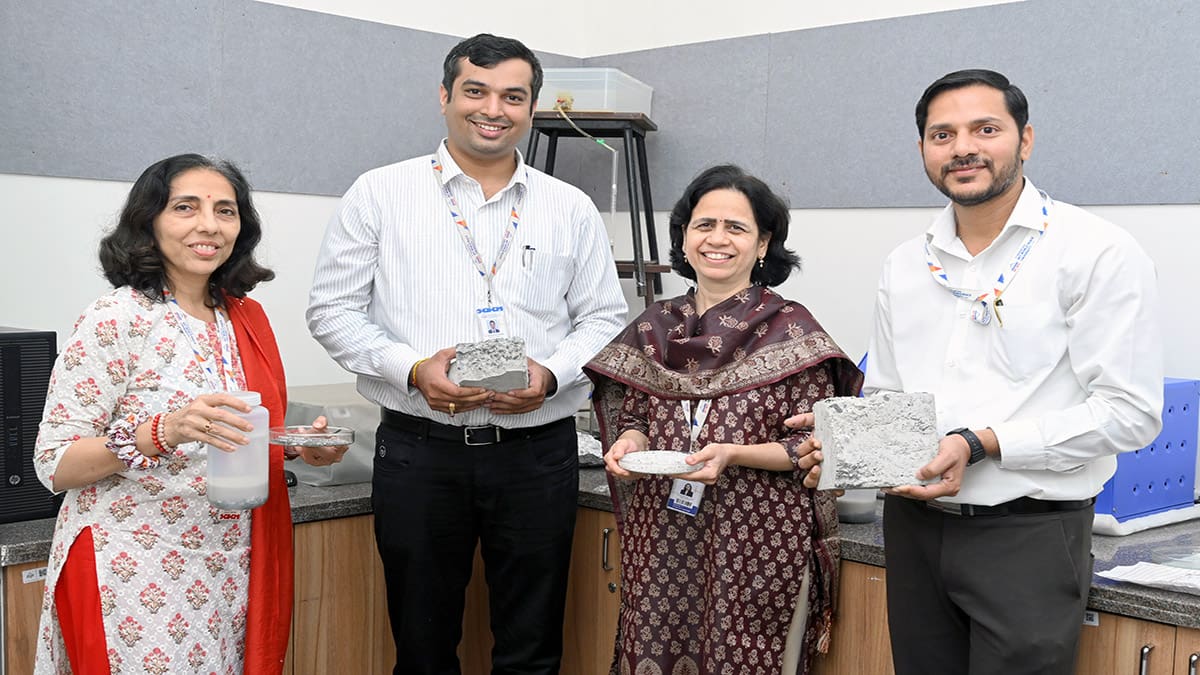

Researchers at MIT World Peace University (MIT-WPU) have developed a scalable and sustainable process to recycle solar photovoltaic (PV) waste, a growing environmental concern as India rapidly expands its renewable energy infrastructure. The team has received a ₹25 lakh research grant from the Rajiv Gandhi Science & Technology Commission (RGSTC), Government of Maharashtra, to advance this pioneering project.
India’s solar PV waste is projected to reach nearly 2,00,000 tons by 2030 and a staggering 1.8 million tons by 2050. Most discarded panels today are either stored or partially dismantled for aluminium and cables, while valuable materials such as silver, copper, tin, and lead are lost due to the complexity of separating laminated, multi-layered panel structures. Addressing this gap, MIT-WPU’s researchers have designed a process that not only enables recovery of these valuable materials but also upcycles non-recoverable fractions into construction materials such as bricks, blocks and aggregates.
Dr Zele emphasised the importance of addressing the environmental footprint of renewable energy technologies, stating, “Solar energy is one of the pillars of India’s clean energy transition, but its by-product solar panel waste is a growing concern. Our research provides a sustainable solution that not only recovers valuable resources but also converts waste into useful construction products. This ensures that renewable energy continues to be truly green and environmentally responsible.”
Echoing this sentiment, Dr Gogate highlighted the interdisciplinary nature of the innovation. “Our process bridges renewable energy and construction, turning a waste challenge into an opportunity. By creating industrial symbiosis, we reduce landfill burden, conserve virgin raw materials, and promote a circular economy. We believe this model can be scaled across India to make solar adoption more sustainable.”
The initiative directly supports India’s clean energy goals and advances the United Nations Sustainable Development Goals (SDGs) 9 (Industry, Innovation, and Infrastructure) and 11 (Sustainable Cities and Communities). By promoting circular industry practices and greener urban development, the project demonstrates how scientific innovation can align with environmental stewardship.
As India continues to accelerate its solar power adoption under national clean energy commitments, MIT-WPU’s pioneering research ensures that the country’s renewable energy revolution remains truly sustainable transforming what could become a waste crisis into a model of green innovation and resource efficiency.