
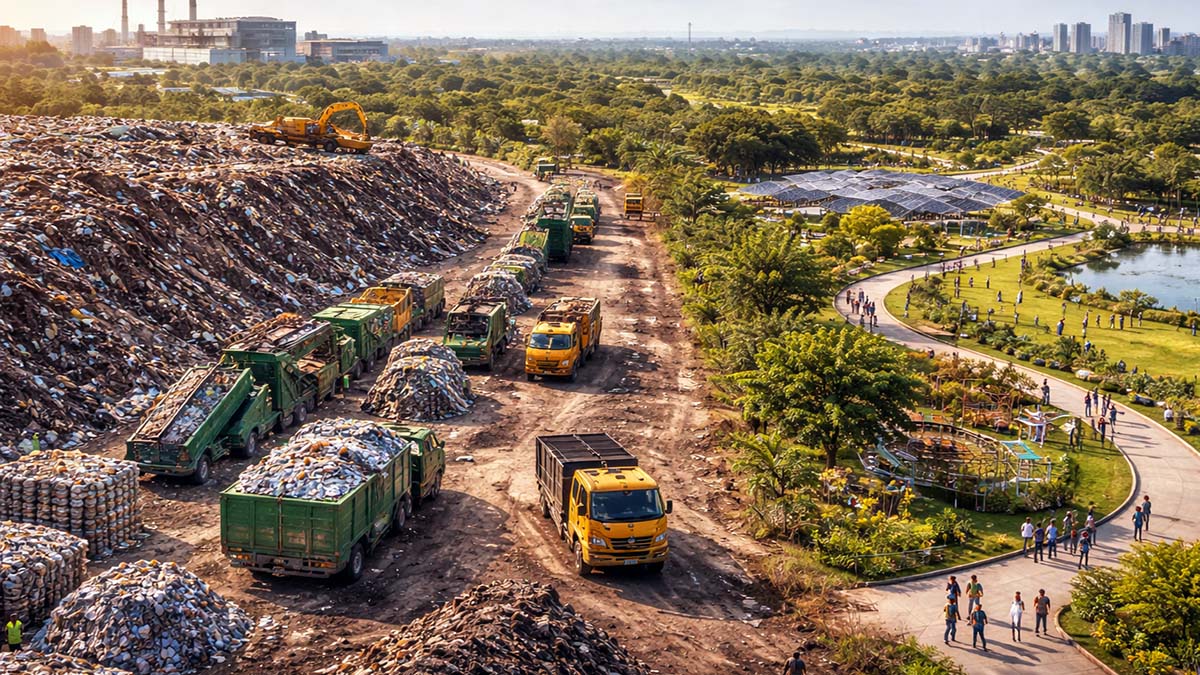

India’s cities are entering a decisive new phase in their long battle with waste. After years of focusing on toilets, door-to-door collection, and street cleanliness, the spotlight has shifted to the towering legacy dumpsites that have loomed over urban skylines for decades. Under the Swachh Bharat Mission, the Government of India has now set an ambitious national target: ‘Lakshya Zero Dumpsites’ by October 2026. At the heart of this push is the Dumpsite Remediation Accelerator Programme (DRAP), launched in November 2025, which aims to scientifically eliminate old waste mountains while ensuring that new ones never emerge.
Across the country, nearly 2,479 dumpsites have been identified, most of them containing decades of unsegregated municipal solid waste. Together, these sites hold an estimated 25 crore metric tonnes of legacy waste spread over roughly 15,000 acres of urban land. These are not just unsightly heaps; they are active environmental hazards. Open dumpsites contaminate soil and groundwater, degrade air quality through toxic emissions, and release methane, a greenhouse gas far more potent than carbon dioxide in the short term. They are also prone to fires, often smouldering for days, and attract disease-carrying vectors, putting nearby communities at constant health risk.
The scale of the challenge is amplified by India’s rapidly growing urban waste generation. Cities already produce about 1.62 lakh tonnes of municipal solid waste every day, and annual waste volumes are projected to rise steeply in the coming decades. Without timely remediation and scientific processing, emissions from the waste sector could climb dramatically, undermining climate goals and worsening local pollution. Against this backdrop, the Zero Dumpsites mission represents both an environmental necessity and an urban governance reform.
Encouragingly, progress is already visible. Remediation is underway at over 1,400 dumpsites, and more than 60 percent of legacy waste has reportedly been processed. Under DRAP, 214 ‘high-impact’ dumpsites together containing nearly 80% of the remaining legacy waste have been prioritised for accelerated action. These sites span 30 States and Union Territories and cover around 200 Urban Local Bodies, making the programme one of the largest coordinated urban clean-up efforts ever attempted in the country. Alongside clearing old waste, the strategy also emphasises building waste-processing capacity to ensure fresh waste is handled scientifically, breaking the cycle of open dumping.
The remediation approach relies heavily on biomining, a method that treats old waste not as useless garbage but as a recoverable resource. In this process, legacy waste is excavated, aerated and stabilised with the help of microbial action. Once dried and stabilised, it is screened into different fractions such as soil-like material, recyclables, and combustible components. This dramatically reduces the volume of material that needs final disposal and allows valuable fractions to be reused. What once stood as a garbage hill can, through careful processing, be transformed into usable inputs for construction, recycling and energy generation.
Different waste streams emerging from biomining follow distinct end uses. Inert and soil-like materials are reused for road construction, embankments and filling low-lying areas, reducing the need for fresh sand and soil extraction. Construction and demolition waste is processed into aggregates, paver blocks and tiles. Combustible fractions are converted into Refuse-Derived Fuel and supplied to cement kilns and waste-to-energy facilities as an alternative to coal. Recyclables such as plastics, metals, glass, and paper are channelled back into recycling industries. Only a small fraction of non-reusable rejects is sent to scientific landfills, ensuring that the era of open dumping is not repeated.
The Zero Dumpsites drive builds on the institutional architecture developed under Swachh Bharat Mission-Urban 2.0, launched in 2021. This phase deepened the focus on solid waste management by promoting segregation at source, expanding processing infrastructure, and encouraging scientific disposal. The current remediation push is anchored in a ‘5P’ framework Political Leadership, Public Finance, Partnerships, People’s Participation, and Project Management designed to keep the effort accountable, well-funded and socially inclusive.
Political oversight has been elevated to an unusual degree, with senior leaders directly adopting dumpsites to fast-track decisions and resolve bottlenecks. Financially, cities are supported through central assistance linked to the quantity of legacy waste, with thousands of crores of rupees already approved for priority sites. Partnerships extend from public works departments and the National Highways Authority of India, which can absorb inert material for infrastructure, to cement plants and waste-to-energy operators that utilise Refuse-Derived Fuel. Technical institutions, private engineering firms, and civil society groups also play roles in design, validation, worker safety and community outreach.
For communities living near dumpsites, the transformation is deeply personal. Years of exposure to foul odour, smoke and contamination have shaped daily life. The programme therefore integrates health camps, awareness drives, and improved safety standards for sanitation workers and informal waste pickers, aiming to make remediation not just an engineering exercise but a social intervention. Reclaimed land is slated for green cover, parks, or solid waste infrastructure, turning former pollution hotspots into assets for neighbourhoods.
At the same time, the broader waste-processing ecosystem is being strengthened to prevent future backlogs. Thousands of Material Recovery Facilities are being expanded or mechanised, composting capacity for wet waste is rising and bio methanation and compressed biogas plants are being rolled out. Larger cities are adding waste-to-electricity capacity to handle non-recyclable dry waste. Together, these facilities form the backbone of a circular economy approach, where waste is seen as a resource stream rather than a burden.
If the 2026 target is met, the impact will extend far beyond cleaner cityscapes. Eliminating legacy dumpsites will cut methane emissions, reduce groundwater contamination and lower the risk of fires and toxic air episodes. It will also free up thousands of acres of urban land for productive use, easing pressure on expanding cities. In policy terms, the mission aligns closely with global sustainable development goals on sustainable cities, responsible consumption and climate action, while advancing India’s longer-term vision of environmentally resilient urban growth.
The road ahead remains demanding, given the sheer volume of waste and the diversity of local conditions. Yet the Zero Dumpsites initiative signals a shift in mindset from managing visible waste to tackling the buried environmental debts of past decades. By combining technology, finance, political will, and community engagement, India is attempting one of the most ambitious urban clean-ups in the world, turning garbage mountains into a test case for circular, climate-conscious urban development.