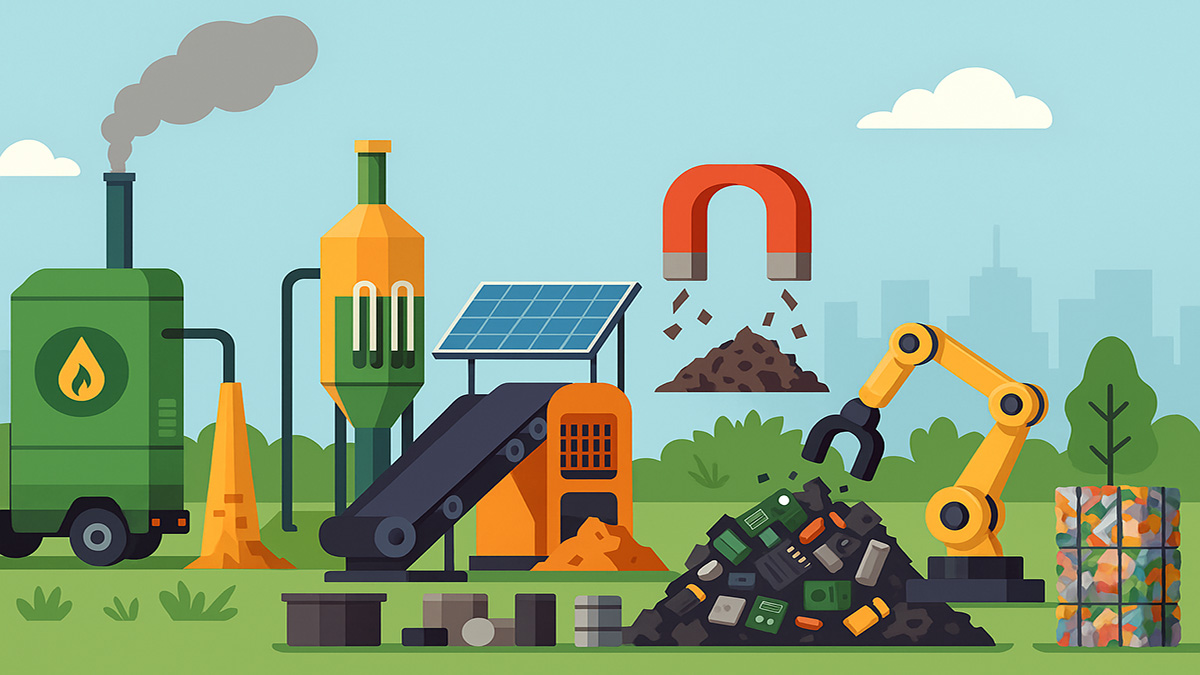

India is stepping up its transition towards a circular economy with a broad set of pilot projects, technology demonstrations and commercial-scale initiatives aimed at strengthening the country’s non-organic solid waste management ecosystem. Multiple government departments including the Department of Science and Technology (DST), Council of Scientific and Industrial Research (CSIR), Ministry of Electronics and Information Technology (MeitY) and other agencies are driving technology development and commercialisation through industry partnerships, start-up support and technology transfers.
Officials clarified that commercialisation of waste-to-wealth technologies remains demand-driven, dependent on regulatory approvals and readiness of industry adopters, and therefore no fixed national timelines have been prescribed. Nonetheless, advanced recycling and waste-processing systems have already been deployed across several states, with the Central Pollution Control Board (CPCB) and State Pollution Control Boards overseeing performance standards and approval processes.
DST has supported a range of projects addressing plastics, e-waste, battery recycling, rare earth recovery and composite materials. Among the key initiatives is the demonstration of ICT–Poly Urja Technology via a vehicle-mounted mobile plant developed by ICT Mumbai, which converts diverse plastic waste streams into fuel, enabling on-site assessments. IIT Madras has established a zero-discharge pilot plant capable of processing 100 kg of printed circuit boards to recover valuable metals such as lead, tin and copper.
At IIT Kharagpur, researchers have developed processes for selective recovery of rare earth elements from spent NdFeB magnets, while Gati Shakti Vishwavidyalaya in Vadodara has demonstrated solar pre-heated thermochemical conversion of mixed municipal plastic waste into high-quality ‘plasto-fuels’. Additional DST-backed projects include recycling graphite from spent lithium-ion batteries at IISER Tirupati and CSIR-NML Jamshedpur, repurposing spent batteries into electrocatalysts and raw materials at IIT Madras, and producing recycled polymer composites from plastic waste at IIT Bombay.
CSIR laboratories have simultaneously advanced several pilot technologies. CSIR-NML Jamshedpur has commissioned a plant to recycle spent lithium iron phosphate batteries for recovery of lithium, iron and phosphorus. CSIR-IIP in Dehradun operates a one-ton-per-day pilot facility that chemically recycles waste plastics into diesel. For steel slag utilisation, CSIR-CRRI is working with major steel companies including TATA Steel, JSW, AMNS India and RINL, along with public agencies such as NHAI, BRO and Adani Ports to demonstrate slag-based road construction solutions. Pilot studies also examined the use of jarofix in Rajasthan, red mud in Odisha, copper slag in Tamil Nadu and phosphogypsum in Odisha for road and infrastructure applications.
In the e-waste sector, MeitY has intensified efforts to develop cost-effective recycling technologies and strengthen capacity building. A Centre of Excellence on e-waste management has been established at CMET Hyderabad with support from the Telangana government and industry partners. The Centre aims to advance indigenous recycling technologies, empower informal-sector recyclers and support safe disposal and precious-metal recovery from discarded electronics. Separately, Bhabha Atomic Research Centre has developed a method to produce high-purity copper oxide nanoparticles from depopulated printed circuit boards, a technology that has already been transferred to six private firms for commercial deployment.
Beyond waste-processing plants, the government is nurturing domestic capabilities in the critical area of rare earth materials, crucial for sectors such as renewable energy, electronics and electric mobility. Multiple pilot-scale facilities have been set up for the preparation and extraction of neodymium, praseodymium and NdFeB magnets. These include MeitY’s pilot facility at CMET Hyderabad for producing Nd and Pr metals and NdFeB magnets; a DST-ANRF-backed pilot plant at ARCI Hyderabad for near net-shaped Nd-Fe-B magnets using NPLP technologies; a DST-TDB-supported commercial-scale facility at Midwest Advanced Materials Private Limited in Hyderabad; the Ministry of Mines’ TRL-7 plant operated by Ashvini Rare Earths for extracting Nd-Pr metals from oxide; and BARC’s Rare Earth & Titanium Theme Park, hosted by IREL (India) in Bhopal, which houses pilot-scale installations for producing neodymium and praseodymium.
Under the Solid Waste Management Rules, 2016, CPCB continues to evaluate proposals from state pollution control boards for new waste-processing technologies while urban local bodies and panchayats are responsible for facilitating waste-processing infrastructure, either independently or through public-private partnerships. The Ministry of Mines is further supporting start-ups and MSMEs engaged in recycling, metallurgy, mineral processing and mining research under the S&T-PRISM initiative.