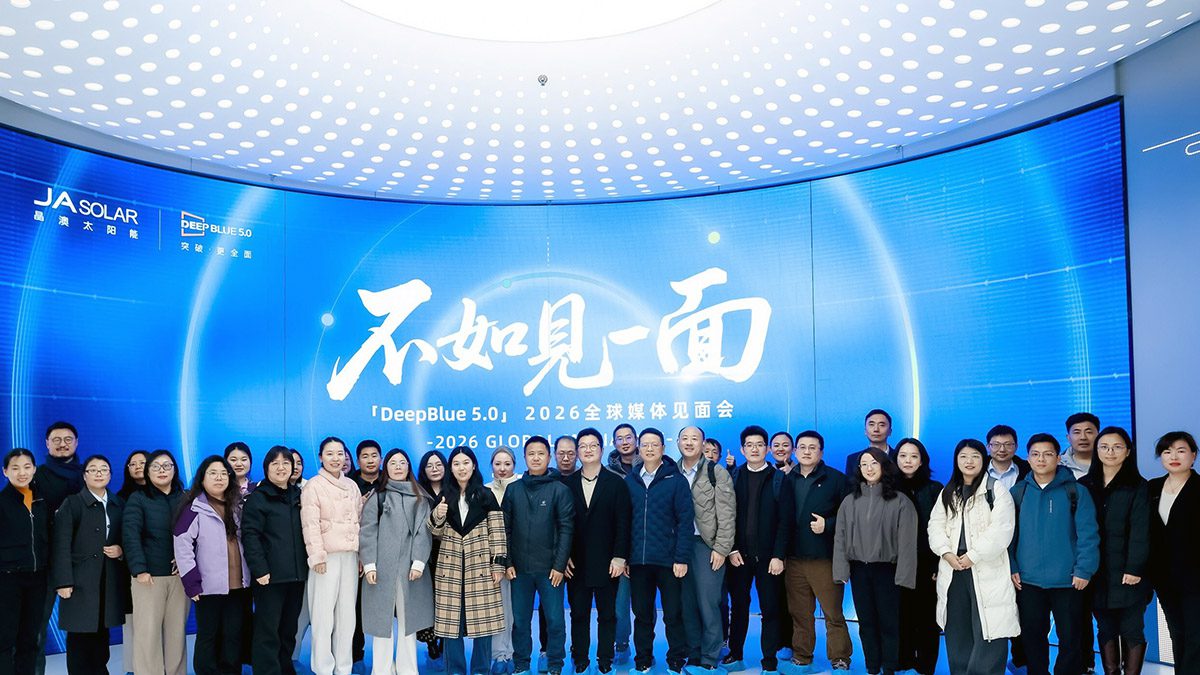

Global attention turned to JA Solar after the company hosted nearly thirty leading international solar and energy media outlets at its Yangzhou manufacturing and testing facilities. The visit offered an exclusive look at DeepBlue 5.0, JA Solar’s next-generation flagship photovoltaic module, marking the company’s first system-level public presentation of the product’s research, development logic, manufacturing advancements, and real-world performance validation.
During the event, Sure Liu, President of Brand and Marketing at JA Solar, emphasised that the photovoltaic industry is entering a new phase where value creation is becoming more important than sheer scale expansion. He noted that future mainstream PV products must deliver more than incremental improvements in performance metrics. According to Liu, the focus must shift toward comprehensive customer value, including higher efficiency, improved land-use efficiency, and stronger project returns. He highlighted that the next generation of solar technologies must begin with a value-driven design philosophy that enhances the overall capabilities available to customers.
DeepBlue 5.0 represents JA Solar’s effort to deliver such value through integrated technological innovation. The module achieves a maximum power output of 670 watts with a conversion efficiency of 24.8 percent, placing it among the most advanced high-performance solar modules currently under development. These gains have been achieved through coordinated improvements across multiple levels of photovoltaic engineering, including wafers, cells, module structures, materials, and manufacturing processes.
One of the most visible design changes in DeepBlue 5.0 is its bezel-free, full-screen architecture, which increases the active generation area while also presenting a clean and unified visual design. The module also introduces a triangular dispersion layout combined with CSE structural reinforcement, designed to improve mechanical load resistance, damp-heat reliability, and hot-spot management. These structural improvements aim to ensure greater durability and stability in demanding operating environments.
The module’s performance gains are further supported by enhancements that improve weak-light response, optimise backside reflection, and increase the utilisation of light arriving from multiple angles. These upgrades help maintain higher energy output across a wider range of real-world conditions. In addition, a dust-mitigation frame and system-level solutions have been developed to ensure consistent energy generation across commercial, industrial, and residential solar installations.
Ouyang Zi, President of JA Solar’s Product and Solutions R&D Center, provided deeper insight into the technologies that underpin the module’s performance. DeepBlue 5.0 incorporates low-oxygen, high-lifetime wafers along with the company’s Bycium+ 5.0 n-type passivated-contact solar cells, which achieve an open-circuit voltage of approximately 749 millivolts. At the module level, the product integrates several innovations including PII interconnection technology, HDP high-density encapsulation, UTG optical optimisation, and CSE structural reinforcement, all designed to enhance efficiency, reliability, and long-term output.
As part of the visit, media representatives toured JA Solar’s outdoor testing base in Yangzhou. The facility includes advanced testing infrastructure such as solar tracking systems, ground surfaces with different reflectivity levels, and simulated commercial and rooftop installation environments. These setups allow engineers to analyse module performance under varied real-world conditions.
Data collected from the DeepBlue 5.0 test arrays showed notable improvements in per-watt energy yield when compared with reference systems operating alongside them. The results, shared during the demonstration, indicated that the module’s design improvements translate directly into higher energy generation in operational environments.
According to Ouyang Zi, DeepBlue 5.0 reflects a complete innovation cycle that moves from research and development to validated field performance. By combining technological upgrades with transparent testing and system-level optimisation, the module demonstrates how solar technology is evolving beyond capacity expansion toward delivering measurable long-term value for project developers and energy producers. With these developments, JA Solar positions DeepBlue 5.0 as a new benchmark for the photovoltaic industry as it transitions toward a more value-driven phase of growth.