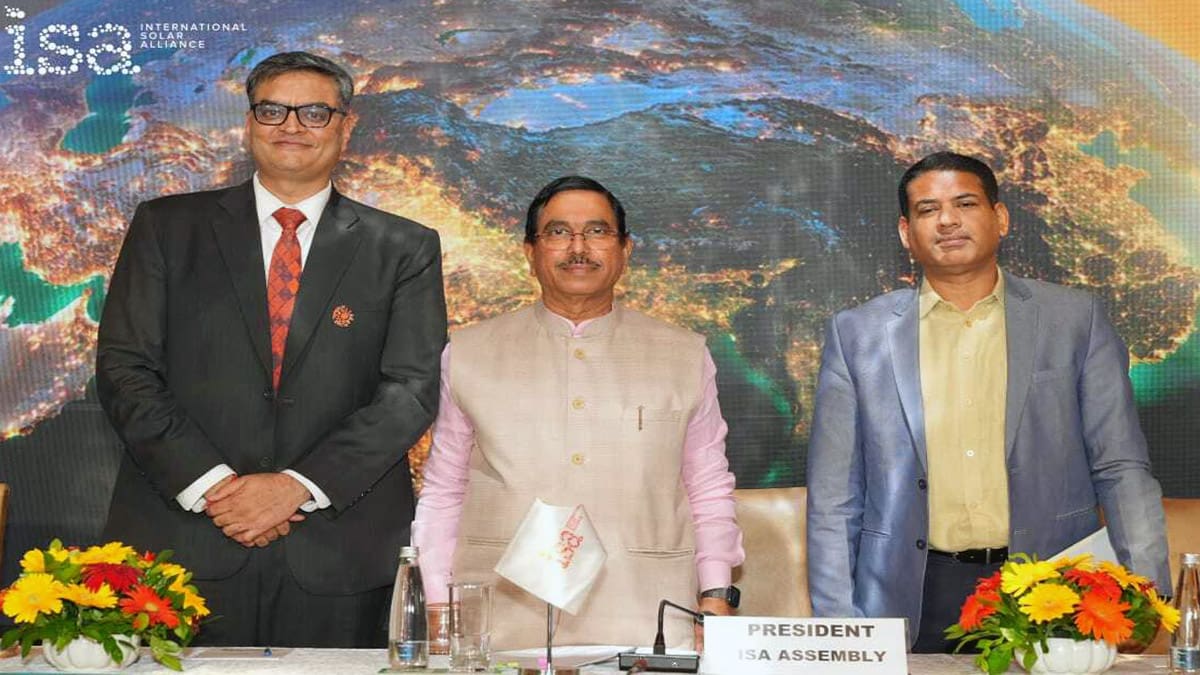

The International Solar Alliance (ISA) hosted the curtain raiser for its Eighth Assembly in New Delhi today, setting the stage for a global convergence on solar energy. The main Assembly session, to be held from October 27–30, 2025, at Bharat Mandapam, will unite representatives from 124 Member and Signatory Countries under the theme “One Sun, One World, One Grid.”
Launched by India and France at COP21 in Paris, the ISA has evolved into the largest treaty-based intergovernmental organisation from the Global South. This year’s high-level ministerial gathering is expected to shape global priorities on scaling solar energy deployment, unlocking catalytic finance, developing technology and policy roadmaps, and fostering skill ecosystems for a just and inclusive energy transition.
Speaking at the curtain-raiser event, Pralhad Joshi, Union Minister for New and Renewable Energy and President of the ISA Assembly, highlighted India’s achievements in renewable energy. “India achieved its renewable energy targets five years ahead of schedule, with over 50% of our installed electricity capacity now coming from non-fossil sources,” he said. “With approximately 125 GW of solar capacity, India stands as the world’s third-largest solar producer. This success is not just about numbers, it’s about transforming lives through decentralised solar power that lights rural homes, energises health centres, and empowers farmers.”
Referring to the government’s flagship initiatives, Joshi cited the PM Surya Ghar – Muft Bijli Yojana, which has benefitted over 20 lakh households, and the PM-KUSUM scheme, which is driving solar transformation in India’s agricultural heartland. “Through KUSUM, we aim to install 10 GW of small solar plants, support 1.4 million off-grid solar pumps, and solarise 3.5 million grid-connected pumps,” he added. “This blend of scale and inclusiveness defines India’s energy transition.”
Santosh Kumar Sarangi, Secretary, Ministry of New and Renewable Energy, underlined India’s global standing in renewable energy. “India is now the third-largest in solar power, fourth in wind power, and the third-largest overall in renewable installations,” he said. “We are also the second-largest manufacturer of solar modules after China, and we are expanding into green hydrogen production, targeting 5 million tonnes by 2031.”
He praised ISA’s pivotal role in fostering collaboration and knowledge-sharing among member countries. “Our partnerships under ISA have yielded promising results, especially in Africa,” Sarangi noted. “India stands ready to support other nations in replicating our solar success stories, such as household solarisation under PM Surya Ghar and agricultural solarisation through PM-KUSUM.”
ISA Director General Ashish Khanna described this moment as a global turning point for renewable energy. “It took oil 25 years to reach 1,000 GW renewables achieved that in just two years,” he said. “For the first time, renewable generation has surpassed fossil generation. The Global South now has an opportunity to lead. Our goal is to move from dialogue to delivery, from commitments to concrete projects, and from potential to measurable impact.”
Recalling Prime Minister Narendra Modi’s vision at the first ISA Assembly in 2018, Khanna emphasised ISA’s mission to harmonise technology standards, promote innovation, and enhance data-driven solar planning. He also introduced the Global Capability Centre (GCC), envisioned as a “Silicon Valley for Solar,” connecting with global STAR-C hubs to provide technical expertise, digital tools, and training.
The upcoming Eighth Assembly will focus on four key strategic pillars: Catalytic Finance Hub; Global Capability Centre & Digitisation; Regional & Country-Level Engagement; and Technology Roadmap & Policy. The discussions will include advancing catalytic finance through the Africa Solar Facility, supporting Small Island Developing States (SIDS) through dedicated platforms for finance and capacity building, and scaling innovation in areas like floating solar, green hydrogen and AI-driven energy planning.
ISA’s flagship reports, Ease of Doing Solar 2025 and Solar Trends 2025, will also be released during the session, outlining global progress and future pathways for solar deployment.
Ahead of the Assembly, ISA convened regional committee meetings across Europe, Asia-Pacific, Latin America & the Caribbean, and Africa between June and September 2025. These meetings, attended by representatives from over 100 countries, reviewed regional progress and developed recommendations on catalytic finance, innovation and solarisation for energy access, all of which will inform the Assembly’s deliberations later this month.
With the Eighth Assembly approaching, the ISA continues to reinforce its position as a unifying global platform for solar energy, driving collaboration and action toward a sustainable, inclusive, and solar-powered future.