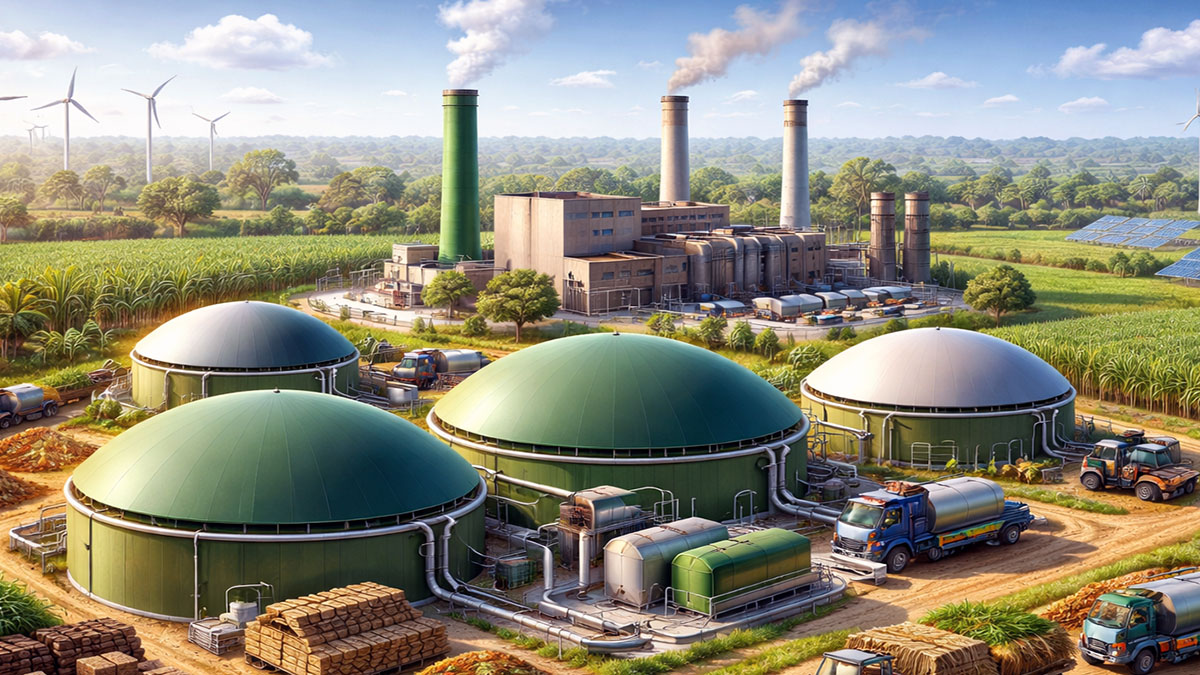

India has significantly expanded its bioenergy footprint over the past decade, adding 2,361.43 MW of biomass-based power capacity, 227.56 MWe of waste-to-energy capacity and installing more than 2.88 lakh biogas plants across the country, according to data presented in Parliament by MoS for New and Renewable Energy Shripad Yesso Naik. The expansion has been driven through a series of central schemes implemented over the last ten years and more recently, under the National Bioenergy Programme (NBP), Phase-I.
The Ministry of New and Renewable Energy is currently supporting bioenergy projects under NBP Phase-I, which was notified on November 2, 2022, with a budgetary outlay of ₹998 crore for the period from 2022-23 to 2025-26. The programme aims to promote energy generation from biomass, biogas, bio-CNG and waste, while also encouraging decentralized energy solutions in rural and semi-urban areas.
During the last decade, bioenergy deployment was supported through multiple schemes, including the National Biogas and Manure Management Programme during the 12th Five Year Plan, the New National Biogas and Organic Manure Programme between 2018-19 and 2020-21, schemes promoting grid-interactive biomass power and bagasse cogeneration in sugar mills, programmes focused on energy from urban, industrial and agricultural waste and dedicated schemes for biomass-based cogeneration in sugar mills and other industries.
Under the current National Bioenergy Programme, the Centre provides Central Financial Assistance for a wide range of technologies. For waste-to-energy projects, assistance includes ₹0.25 crore per 12,000 cubic metres per day of biogas generation capacity, up to ₹4 crore per 4,800 kg per day for bio-CNG from new biogas plants and ₹3 crore for the same capacity from existing plants. Power generation from biogas is supported with up to ₹0.75 crore per MW for new plants and ₹0.5 crore per MW for existing plants, while power projects based on bio and agro-industrial waste receive ₹0.4 crore per MW. Biomass gasifiers are also supported for electrical and thermal applications at rates ranging from ₹2,500 per kWe to ₹15,000 per kWe and ₹2 lakh per 300 kWth, depending on the configuration.
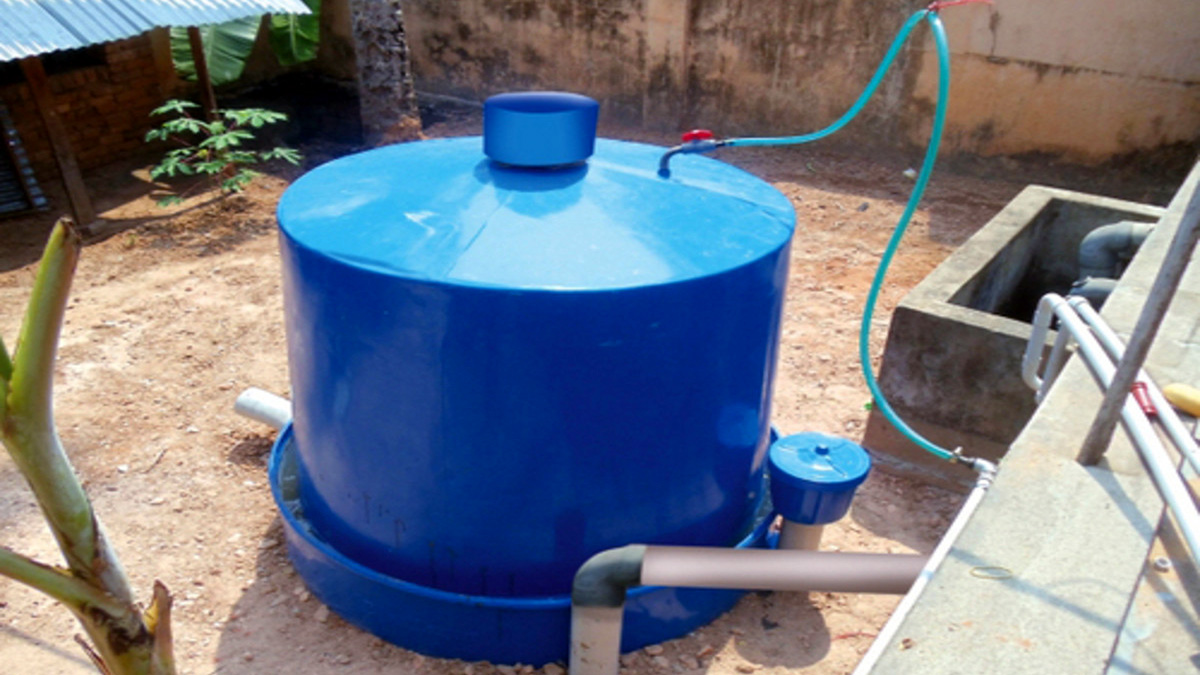
The biomass programme provides assistance for briquette manufacturing plants at ₹9 lakh per tonne per hour of capacity, pellet manufacturing plants at up to ₹21 lakh per MTPH for non-torrefied pellets and ₹42 lakh per MTPH for torrefied pellets, subject to project caps. Non-bagasse cogeneration projects are eligible for ₹40 lakh per MW, with a ceiling of ₹5 crore per project. Under the biogas programme, small biogas plants with capacities between 1 and 25 cubic metres per day receive assistance ranging from ₹9,800 to ₹70,400 per plant, while larger plants meant for power and thermal applications receive support linked to installed kilowatt capacity. Beneficiaries in the North Eastern Region, islands, registered gaushalas and SC/ST categories are eligible for 20% higher assistance than standard rates.
State-wise data show that Maharashtra has emerged as the largest contributor to biomass power capacity, with 1,073.5 MW installed, followed by Karnataka with 536.81 MW, Punjab with 140.29 MW and Uttar Pradesh with 146.6 MW. Other major contributors include Tamil Nadu with 112.55 MW, Haryana with 87.4 MW and Chhattisgarh with 54 MW. In waste-to-energy capacity, Uttar Pradesh leads with 41.34 MWe, followed by Andhra Pradesh at 35.95 MWe, Maharashtra at 24.26 MWe, Delhi at 24.17 MWe and Punjab at 21.77 MWe.
Biogas plant deployment has been particularly widespread, with Maharashtra accounting for 71,653 plants, Karnataka 34,657 plants, Madhya Pradesh 32,120 plants, Andhra Pradesh 28,505 plants and Assam 23,612 plants. Punjab has installed 19,288 biogas plants, while Kerala, Telangana, Uttarakhand and Odisha have also recorded significant numbers. In total, 2,88,079 biogas plants have been set up across states and union territories during the last ten years.