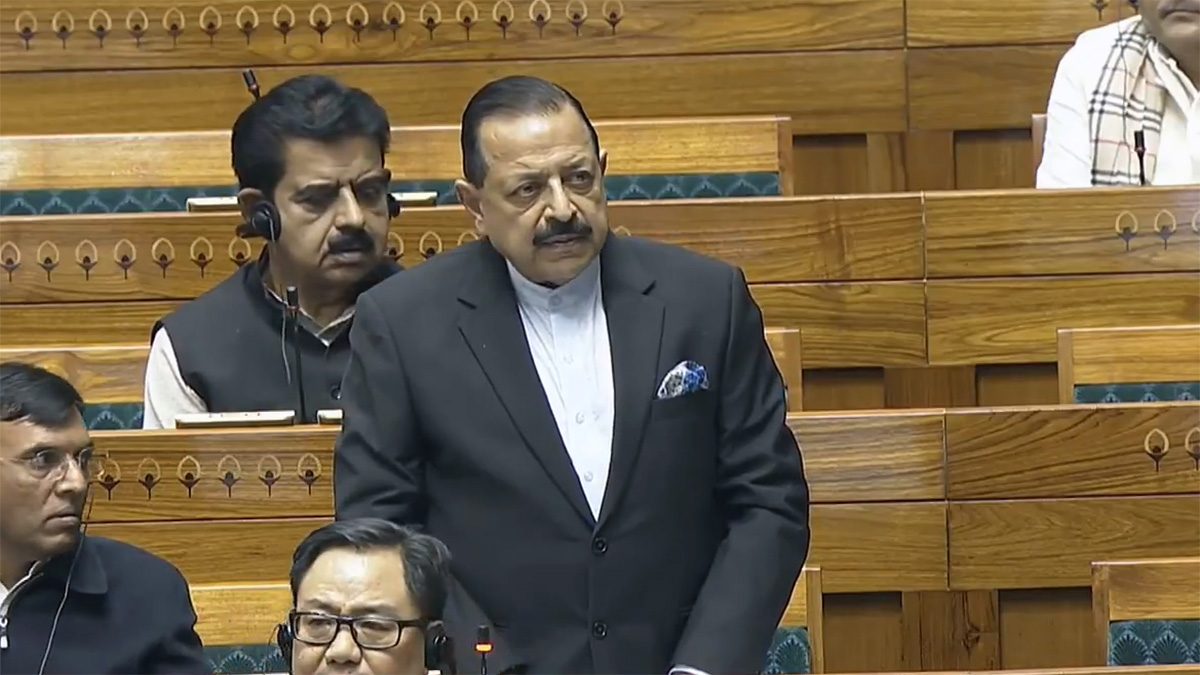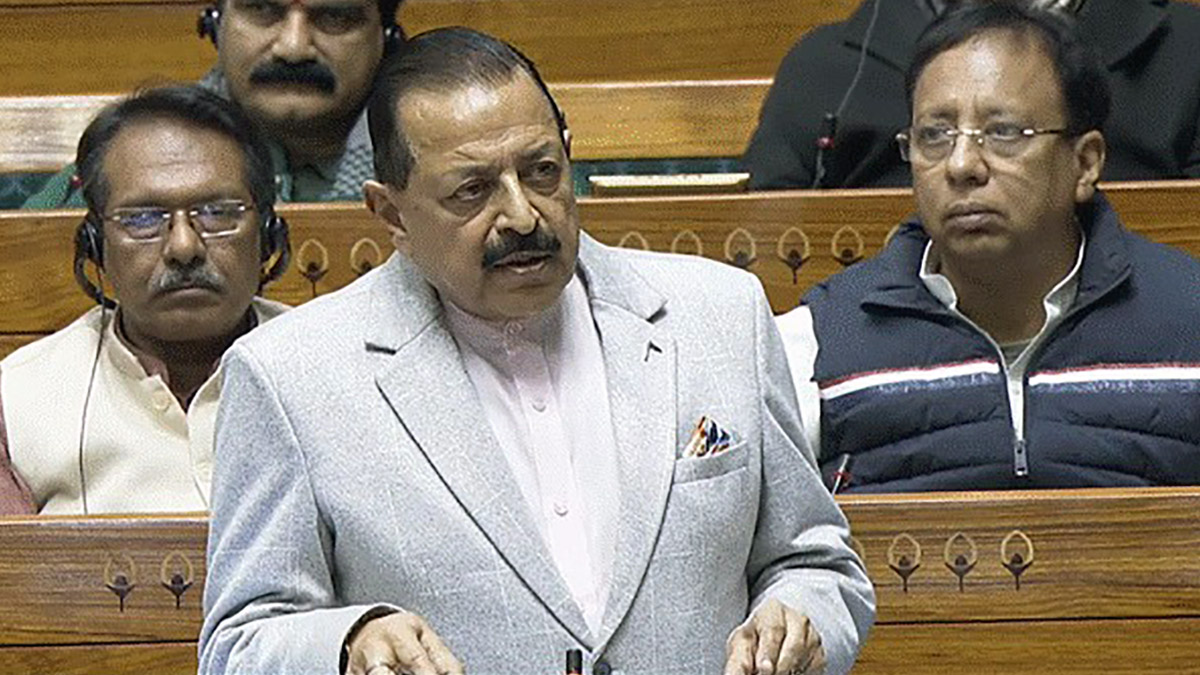

Union Minister of Science and Technology Dr Jitendra Singh assured the Lok Sabha that the proposed Sustainable Harnessing and Advancement of Nuclear Energy for Transforming India (SHANTI) Bill, 2025 preserves and strengthens India’s long-standing safety, security and liability safeguards, even as it seeks to modernise the country’s nuclear energy framework.
Replying to an extensive debate in the House, the Minister said the Bill is designed to align India’s nuclear laws with contemporary technological, economic and energy realities, while remaining firmly rooted in the principles established under the Atomic Energy Act of 1962.
A key feature of the Bill, Dr Singh said, is the move to grant statutory status to the Atomic Energy Regulatory Board (AERB), which has so far functioned under an executive order. This, he noted, would enhance regulatory independence and transparency, while ensuring rigorous oversight of nuclear safety. He emphasised that government control over sensitive areas such as fissile material, spent fuel and heavy water will continue unchanged, irrespective of any private sector participation.
Addressing concerns over nuclear liability, a central issue raised by several Members, the Minister said the Bill does not dilute compensation for victims of nuclear incidents. Instead, it introduces a rationalised, graded operator liability structure linked to reactor size, aimed at facilitating the adoption of newer technologies like small modular reactors. At the same time, he said, victims would have access to full compensation through a multi-layered mechanism comprising operator liability, a proposed government-backed Nuclear Liability Fund and additional coverage through India’s participation in the Convention on Supplementary Compensation.
Dr Singh clarified that supplier liability has been removed after careful consideration of global best practices and advances in reactor safety, but added that provisions relating to negligence and penal action remain fully enforceable under Indian law.
Rejecting suggestions that the Bill undermines public sector capabilities, the Minister highlighted a nearly 170% increase in the Department of Atomic Energy’s budget over the past decade and a doubling of installed nuclear capacity since 2014. He pointed out that despite this progress, nuclear power still forms a relatively small share of India’s energy mix compared to other major economies.
To meet India’s growing energy needs driven by sectors such as data processing, healthcare and industry alongside its climate commitments, Dr Singh said scaling up nuclear power is essential. The SHANTI Bill, he added, enables responsible private and joint venture participation to address resource constraints, reduce project gestation periods and support the national target of achieving 100 GW of nuclear capacity by 2047.
Placing the legislation in a wider context, the Minister noted that nuclear technology has applications beyond electricity generation, including cancer treatment, agriculture and industrial use. He also pointed out that the Bill, for the first time, explicitly includes environmental and economic damage within the definition of nuclear harm.
With dedicated investments proposed for small modular reactors, research and innovation, Dr Singh said the SHANTI Bill aims to create an enabling ecosystem for clean, reliable energy as India approaches the centenary of Independence, while reaffirming the country’s commitment to the peaceful use of atomic energy.