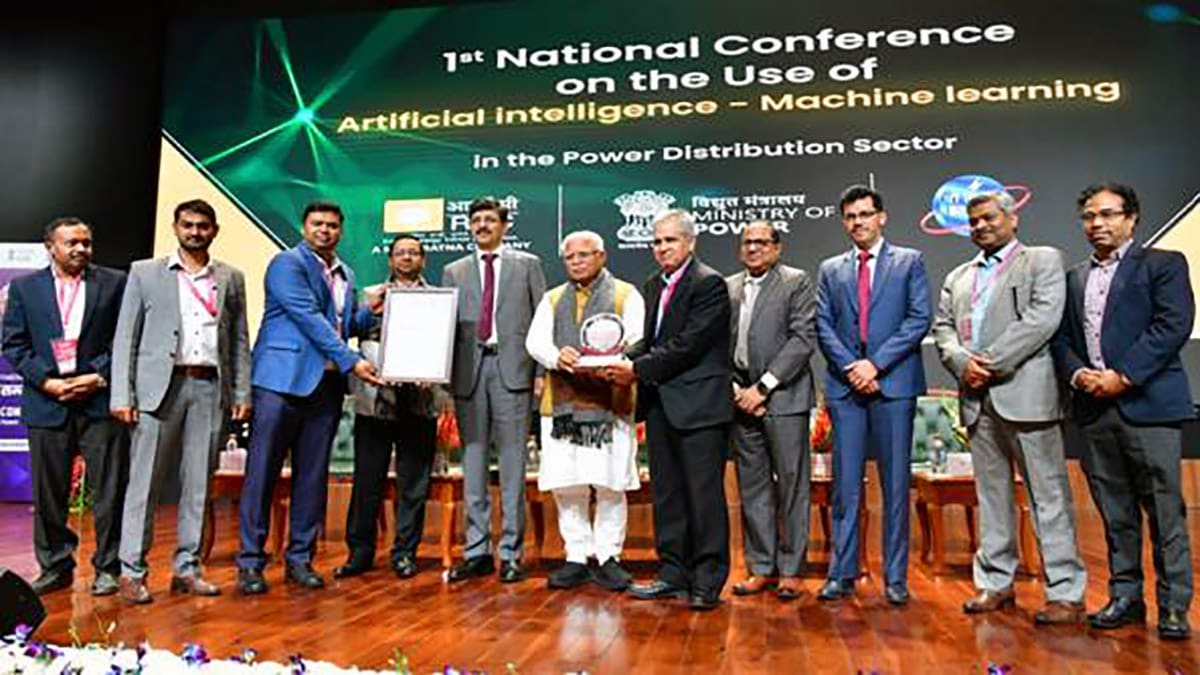

A two-day National Conference on Artificial Intelligence (AI) and Machine Learning (ML) in the power distribution sector concluded today at Bharat Mandapam, New Delhi, marking a major milestone in India’s digital transformation of the electricity ecosystem. Organised under the Revamped Distribution Sector Scheme (RDSS), the conference, held on December 6–7, focused on the theme “Harnessing AI/ML for Smart, Efficient and Sustainable Power Distribution.” The event brought together DISCOMs, technology providers, policymakers, and industry experts to showcase innovations aimed at enhancing grid reliability, operational efficiency, and consumer experience.
Union Power Minister Manohar Lal, addressing the participants, emphasised that AI and ML applications are set to play a pivotal role in creating intelligent, consumer-centric, self-optimising distribution networks. He highlighted the transformative potential of technologies such as smart meter analytics, digital twins, predictive maintenance, theft detection tools, appliance-level consumption insights, automated outage prediction and GenAI-supported decision-making. He also stressed the importance of active consumer engagement to build trust, counter misinformation, and ensure smooth integration of emerging technologies in the power sector.
The conference received an overwhelming response to its national call for innovation, with 195 applications submitted by DISCOMs, Advanced Metering Infrastructure Service Providers (AMISPs), Technology Solution Providers (TSPs), and Home Automation Solution Providers (HASPs). After preliminary screening, 51 solutions were shortlisted and presented to a jury on Day 1. These included real-world use cases featuring smart meter data analytics, integrated IT/OT systems, demand forecasting, revenue protection measures, behavioural demand response, consumer appliance analytics, and IoT- and blockchain-enabled home and grid solutions.
Following detailed evaluation, the winners were announced across multiple categories. In the DISCOM category, TNPDCL (Tamil Nadu) and MP East (Madhya Pradesh) were selected for their data-driven innovations. Tata Power and Apraava Energy emerged as winners in the AMISP category, while Pravah and Flock Energy topped the Technology Solution Providers category. Tata Power also secured the award in the Home Automation Solutions category. Their presentations demonstrated advanced capabilities such as accurate consumer indexing, revenue protection using analytics, unified real-time grid intelligence, AI-based operational automation, and intuitive home energy monitoring systems. The Minister felicitated the winners and encouraged scaling these solutions across states to accelerate India’s digital electricity reform.
The event also saw the launch of STELLAR (Strategic Expansion for Long Term Load Adequacy and Resilience), a new tool developed by the Central Electricity Authority (CEA) to help DISCOMs conduct resource adequacy studies and prepare long-term planning strategies. In addition, the India Smart Grid Forum (ISGF) released a comprehensive Handbook on AI, ML, AR/VR, and Robotics for Electric Utilities, featuring 174 use cases, including 45 contributed by Indian utilities.
Secretary, Ministry of Power, Pankaj Agarwal, reaffirmed the Ministry’s commitment to strengthening digitalisation across power utilities. He underscored the need for capacity building, secure data-sharing protocols, and interoperability frameworks to ensure scalable adoption of innovative solutions nationwide. He further noted that the innovations showcased at the conference reflect India’s readiness to lead the global transition towards a smarter, more resilient, and future-ready electricity distribution ecosystem.
The Conference reinforced a collective vision for leveraging advanced technologies to improve operational efficiency, reduce losses, empower consumers, and build a sustainable power distribution landscape. With strong collaboration between government, industry, and technology innovators, AI and ML are poised to drive the next phase of transformation in India’s power sector.