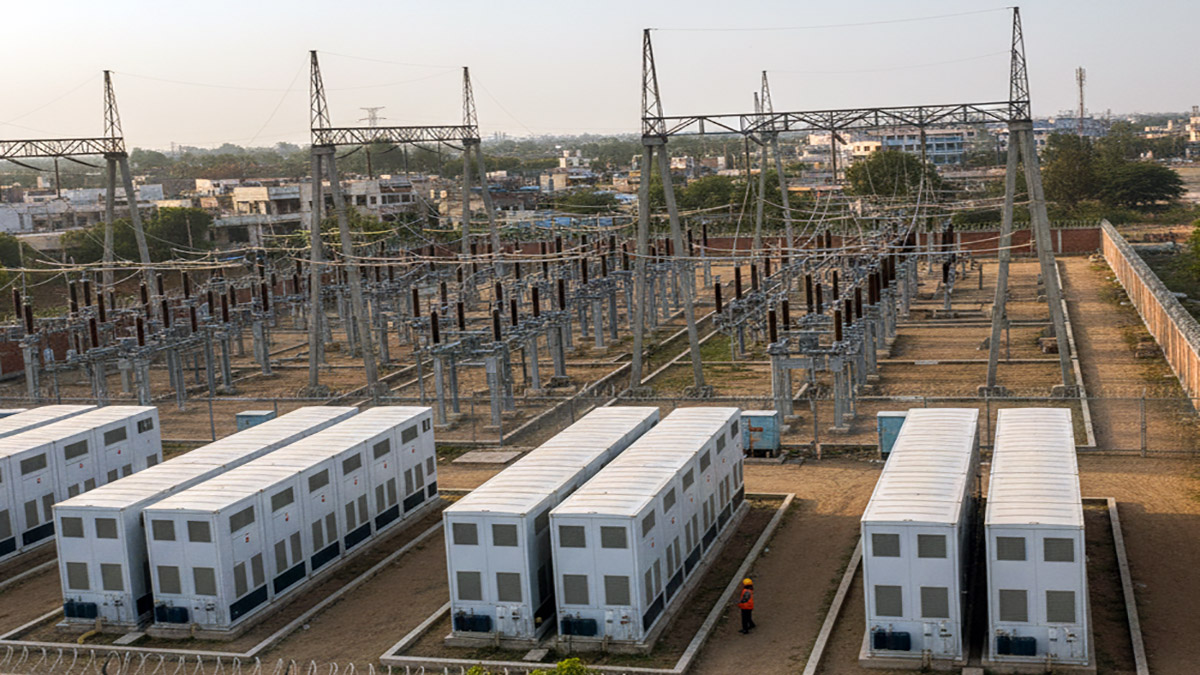

India’s power sector is witnessing a rapid transformation as the cost of battery energy storage systems (BESS) has fallen steeply, supported by competitive bidding, government-backed viability gap funding, transmission charge waivers and a push for domestic manufacturing, alongside expanded international cooperation and sweeping sectoral reforms.
According to data released by the government, the per unit cost of battery storage discovered through tariff-based competitive bidding during 2022–23 stood at about ₹10.18 per kWh, assuming two charge-discharge cycles per day. In recent tenders, however, the discovered cost has dropped sharply to around ₹2.1 per kWh without viability gap funding, again assuming two daily cycles. Based on prevailing market trends, battery storage is expected to be utilised for around 1.5 cycles per day, translating into an effective storage cost of approximately ₹2.8 per kWh. This brings battery storage close to parity with solar generation, where recent tenders have discovered average tariffs in the range of ₹2.5 per kWh.
To further improve affordability and accelerate deployment, the Ministry of Power is administering a viability gap funding scheme for setting up 13,220 MWh of BESS capacity with budgetary support of ₹3,760 crore. In addition, a second VGF scheme was launched in June 2025 for the development of 30 GWh of battery storage capacity, with financial support of ₹5,400 crore from the Power System Development Fund. Together, these initiatives form part of a broader programme to develop around 43.2 GWh of battery storage capacity across the country.
Transmission cost relief has also emerged as a key enabler. Inter-State Transmission System charges have been waived for 12 years for co-located BESS projects commissioned by June 2028. For non-co-located projects, a full waiver is available for projects commissioned before June 2025, after which the waiver will be reduced annually in graded steps of 25 per cent.
On the manufacturing side, the Ministry of Heavy Industries is implementing the Production Linked Incentive scheme under the National Programme on Advanced Chemistry Cell Battery Storage. Approved in May 2021 with an outlay of ₹18,100 crore, the scheme aims to establish 50 GWh of domestic advanced chemistry cell manufacturing capacity, including 10 GWh earmarked specifically for grid-scale stationary storage. The government expects this initiative to reduce import dependence, attract investment into domestic manufacturing and drive down battery storage costs over the medium to long term.
Parallel to these financial and industrial measures, the Ministry of Power is deepening international cooperation and undertaking comprehensive reforms to modernise the electricity sector. India is engaging with foreign governments and industry partners through bilateral memoranda of understanding and multilateral platforms such as the G20, BRICS, the Clean Energy Ministerial and the International Solar Alliance, while also strengthening regional cooperation under frameworks including SAARC, BIMSTEC, ASEAN, SASEC, the Shanghai Cooperation Organisation and the One Sun One World One Grid initiative.
At the same time, a series of regulatory and institutional reforms has been rolled out to improve governance, grid reliability, consumer protection and renewable energy integration. Rules on late payment surcharge have been notified to ensure timely payments by utilities and create a structured framework for clearing past dues. Green Energy Open Access rules now allow consumers with loads above 100 kW to procure renewable power with time-bound approvals and uniform charges. Frameworks covering renewable consumption obligations, inter-state transmission charge waivers and energy storage deployment have been introduced to facilitate large-scale renewable integration.
India has also adopted a structured resource adequacy framework to ensure energy security through advance demand assessment and capacity procurement, while enabling monthly automatic pass-through of fuel and power purchase adjustment surcharges to improve the financial health of distribution utilities. Consumer-centric reforms, including the Electricity Rights of Consumers Rules, mandate 24×7 power supply and improved service standards.
In April 2025, the Central Electricity Authority launched the STELLAR model, a state-of-the-art, indigenously developed resource adequacy tool that enables states to carry out integrated planning of generation, transmission, storage and demand response. Under the Revamped Distribution Sector Scheme, infrastructure works worth over ₹2.83 lakh crore have been sanctioned, supported by gross budgetary assistance of ₹1.21 lakh crore, with a strong emphasis on smart metering, digitalisation and loss reduction.
Smart meters are being rolled out to enable automated energy accounting, real-time monitoring and improved billing accuracy, while artificial intelligence and machine learning solutions are being promoted for demand forecasting, predictive maintenance and asset management. Energy storage systems have been formally recognised under the Electricity Amendment Rules, 2022, allowing them to be owned, developed or operated by consumers and other power sector entities.
Grid integration measures have also been strengthened through the Green Energy Corridor scheme, under which renewable energy management centres have been established across the country to forecast, schedule and monitor variable renewable energy. Guidelines for automatic weather stations at renewable plants, central financial assistance for state-level transmission infrastructure and mandated flexibilisation of thermal generation are further supporting grid stability. Technical standards for grid connectivity and provisions in the Indian Electricity Grid Code now require renewable plants to participate in frequency control during contingencies.
These domestic reforms are complemented by a wide network of international agreements involving the Ministry of Power and its public sector undertakings, spanning cooperation with countries across South Asia, the Middle East, Europe, Africa, East Asia and North America, as well as institutions such as the US Department of Energy and Lawrence Berkeley National Laboratory. Collectively, these partnerships focus on energy efficiency, grid modernisation, renewable deployment, cross-border power trade and advanced technologies.