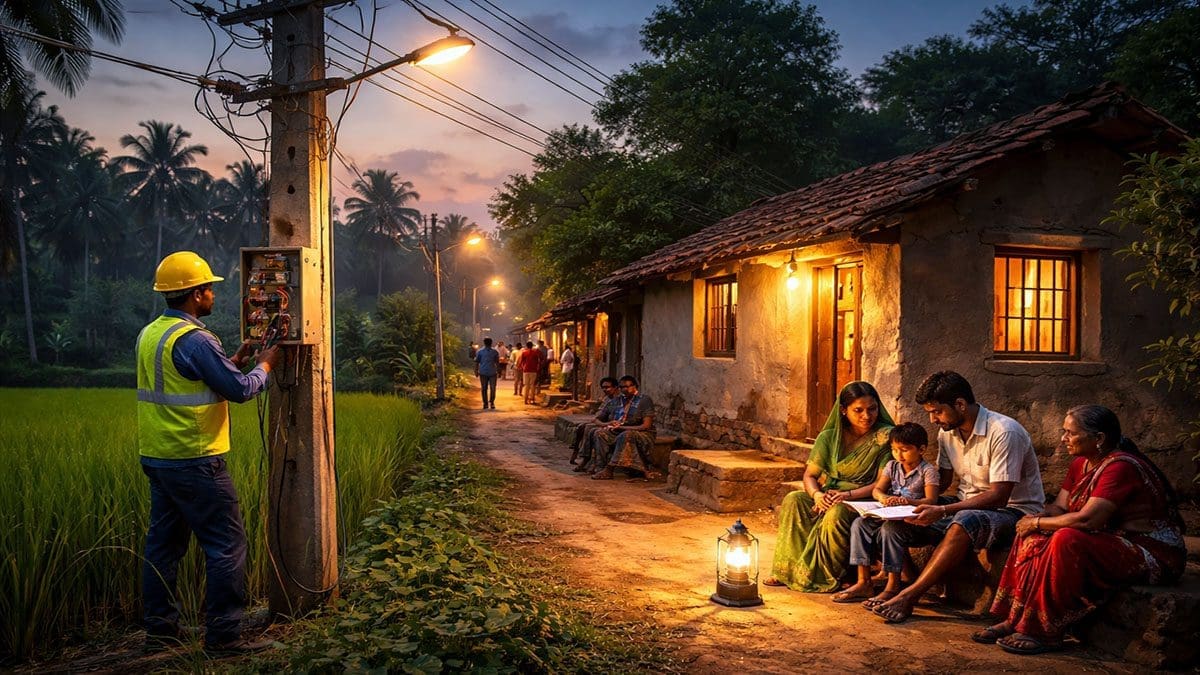

The Government of India has reaffirmed that universal household electrification has been largely achieved across the country under the Pradhan Mantri Sahaj Bijli Har Ghar Yojana (SAUBHAGYA), while additional and targeted electrification efforts are continuing under the Revamped Distribution Sector Scheme (RDSS).
Launched in October 2017, SAUBHAGYA aimed to provide electricity connections to all willing un-electrified households in rural areas and poor households in urban India. According to official data, the total number of un-electrified households at the start of the scheme was estimated at 300 lakhs.
During the implementation period, 2.86 crore households were electrified across the country. All States and Union Territories reported 100% electrification of all willing un-electrified households identified up to March 31, 2019.
Uttar Pradesh accounted for the highest number of electrified households during the SAUBHAGYA period with over 91.8 lakh connections, followed by Bihar (32.6 lakh), Assam (23.3 lakh), Rajasthan (21.3 lakh) and Odisha (24.5 lakh). States such as Madhya Pradesh, Maharashtra, Jharkhand and Chhattisgarh also recorded substantial gains, reflecting the nationwide scale of the programme.
To support the electrification drive, extra-budgetary borrowings were raised through the Rural Electrification Corporation (REC). A total of ₹24,109.30 crore was mobilised ₹2,950 crore for SAUBHAGYA and ₹21,159.30 crore for Deen Dayal Upadhyaya Gram Jyoti Yojana (DDUGJY). The government stated that the entire amount was utilised within the stipulated timeframe.
Building on SAUBHAGYA’s achievements, the government launched RDSS to improve the quality, reliability and financial sustainability of power distribution. Projects worth ₹2.62 lakh crore have been sanctioned under RDSS for infrastructure upgrades and smart metering.
Of this, works amounting to ₹6,522 crore have been approved specifically for the electrification of 13.65 lakh households. These include households belonging to Particularly Vulnerable Tribal Groups (PVTGs) under the PM-JANMAN initiative, tribal households under the Dharti Aaba Janjatiya Gram Utkarsh Abhiyan, Scheduled Caste households under PM-AJAY and households located in remote and border areas covered by the Vibrant Village Programme.
As per the latest figures, 2.91 lakh households have been electrified so far under RDSS against the sanctioned target of 13.65 lakh. States such as Andhra Pradesh, Rajasthan, Madhya Pradesh, Maharashtra, Telangana and Tripura have reported measurable progress, while electrification work in several northeastern and hill states is at an early stage.
Officials noted that RDSS electrification involves challenging terrains, dispersed habitations and remote locations, which require more time for execution compared to earlier phases.
With SAUBHAGYA having delivered near-universal access to electricity, the government’s focus has now shifted to strengthening distribution networks, integrating smart meters and ensuring reliable power supply, particularly for marginalised and hard-to-reach communities.
The ongoing RDSS interventions are expected to bridge remaining gaps and consolidate India’s transition from basic electricity access to quality and sustainable power for all.