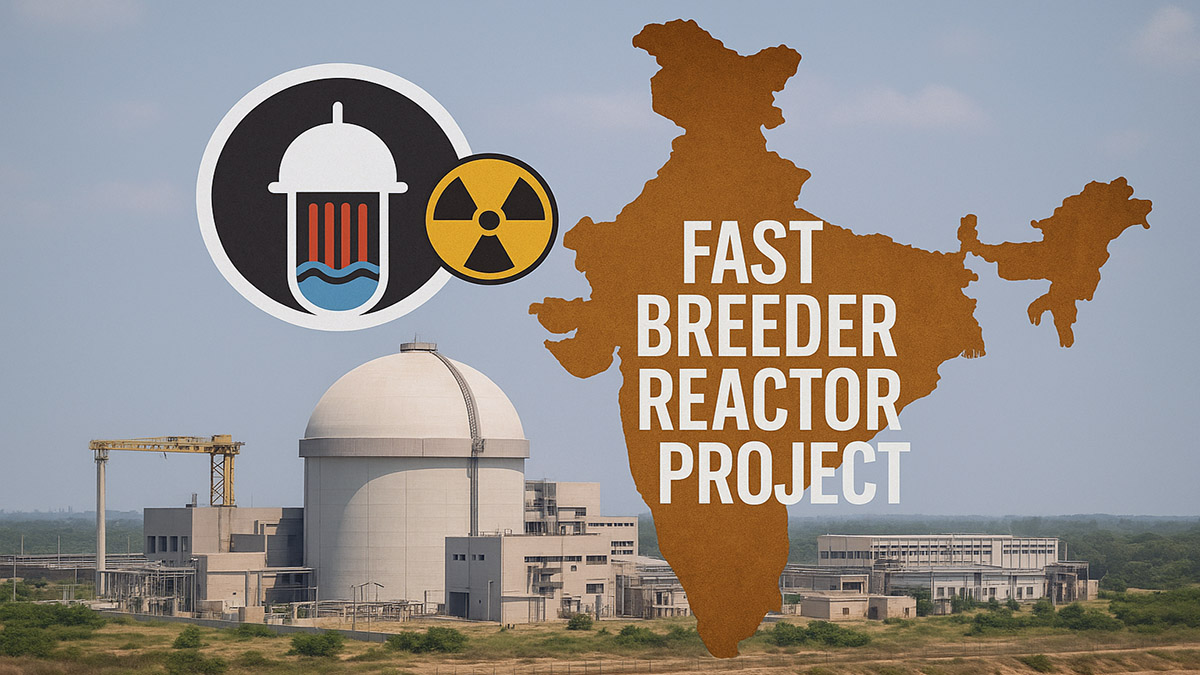

The country’s ambitious Prototype Fast Breeder Reactor (PFBR) at Kalpakkam has reached a significant milestone, with the Atomic Energy Regulatory Board (AERB) granting permission for Initial Fuel Loading (IFL), First Approach to Criticality (FAC) and Low Power Physics Experiments (LPPE). The approval, issued on October 16, 2025, marks steady progress toward commissioning India’s first large-scale fast breeder reactor seen as a pivotal component of the nation’s long-term nuclear energy strategy.
According to the Department of Atomic Energy (DAE), fuel loading is currently underway, with 37 sub-assemblies, 28 of them containing nuclear fuel already being placed into the reactor core. Once the remaining assemblies are loaded, PFBR will move to its next major step: the First Approach to Criticality, when the reactor becomes self-sustaining for the first time.
The progress at PFBR comes amid a broader push to expand India’s nuclear manufacturing capabilities. The DAE highlighted that the domestic ecosystem comprising both public-sector units and private industry has matured significantly. State enterprises continue to supply critical materials such as nuclear fuel, neutron absorbers, heavy water and zirconium alloy products, while also producing fuel assemblies and specialised sensors.
Private industry, meanwhile, has strengthened its role in the nuclear supply chain. A majority of equipment required for 700 MWe Pressurised Heavy Water Reactors (PHWRs), the upcoming 200 MWe Bharat Small Modular Reactor (BSMR-200), and the 55 MWe SMR-55 are already within the capability of Indian manufacturers. Officials note that future expansion of nuclear capacity under the ‘Make in India’ mandate will further stimulate private-sector involvement.
To support this growth, the Bhabha Atomic Research Centre (BARC) continues to assist new vendors, helping them meet demanding nuclear-grade standards.
India’s nuclear ambitions depend not only on reactor development but also on securing key mineral resources. The Atomic Minerals Directorate for Exploration and Research (AMD) is intensifying efforts to identify deposits of uranium, thorium, niobium, tantalum, beryllium, lithium, zirconium, titanium and Rare Earth Elements (REEs).
AMD teams are conducting geophysical, geological, geochemical, and radiometric surveys across geologically promising regions to boost reserves essential for the country’s nuclear power programme and strategic industries.
The PFBR, a first-of-its-kind project designed to breed more fuel than it consumes, is central to India’s three-stage nuclear programme. As the reactor moves closer to criticality, experts say the milestone underscores India’s growing technological confidence and the rising capabilities of its domestic nuclear sector.