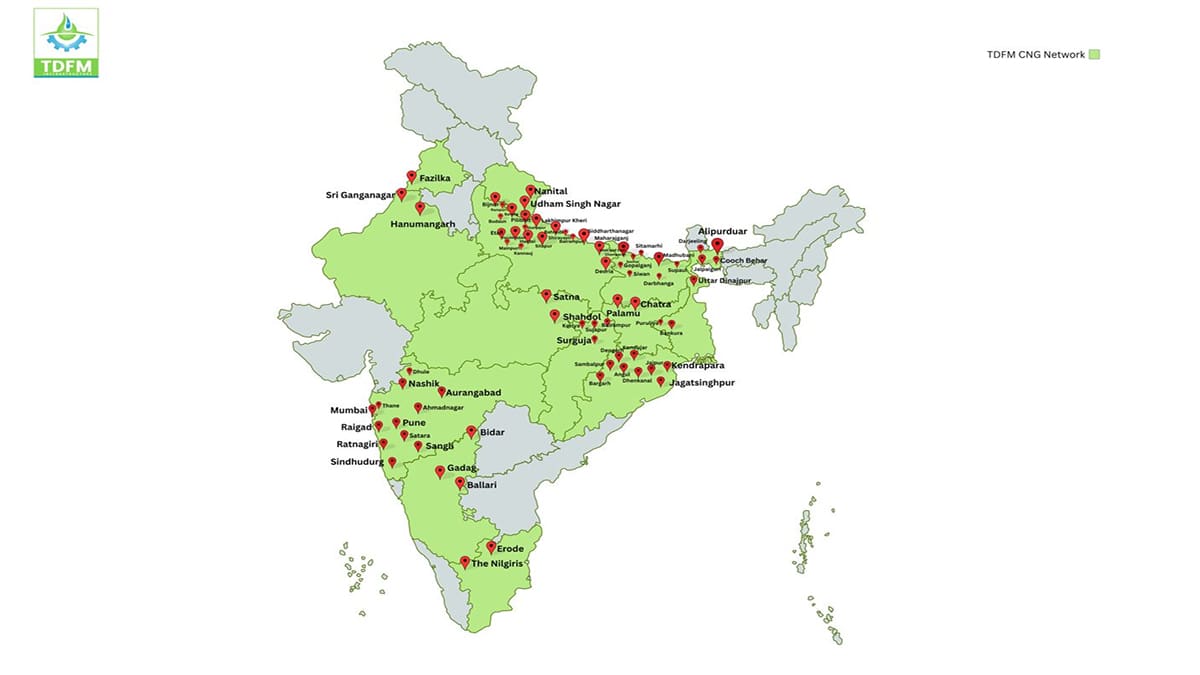

As India accelerates its shift towards sustainable mobility and cleaner energy alternatives, TDFM Inffrastructure Limited has positioned itself at the forefront of this transformative movement. The company has announced the successful completion of a critical phase in the rollout of compressed natural gas (CNG) infrastructure, now spanning 13 states and 74 districts across the country. This development is expected to bring cleaner, more affordable, and reliable fuel options to millions of Indians, significantly contributing to the nation’s clean energy ambitions.
Driven by the Government of India’s Clean Fuel Mandate, TDFM Inffra has laid down a comprehensive and resilient infrastructure network. This includes thousands of kilometres of high-grade pipelines, the construction of 36 technologically advanced compressor stations, and the establishment of 185 public and private CNG filling stations strategically located to maximize access and efficiency. These milestones represent a major leap in India’s effort to reduce dependence on conventional fossil fuels and adopt environmentally responsible alternatives.
According to Jitendr Andhale, Managing Director of TDFM Inffrastructure Limited, the project is about more than just physical infrastructure. “This isn’t just about pipelines, it’s about connecting the dream of a greener India to every household, auto rickshaw, and bus depot,” he said. Andhale highlighted the challenging but inspiring journey his teams undertook from navigating the rocky terrains of Bengal to overcoming the congestion of Maharashtra’s urban sprawl. “Our team has worked with one relentless purpose: to deliver clean fuel, clean air, and clean progress.”
The scale of the project is unprecedented. From the industrial belts of Maharashtra to the rural corners of Odisha, from the northern plains of Uttar Pradesh to the southern reaches of Tamil Nadu, TDFM Inffra’s expansion has touched nearly every region of the country. This nationwide network has not only expanded clean fuel access but also led to tangible environmental and economic benefits. The company estimates that the initiative will reduce carbon dioxide emissions by 1.2 million tons annually, equivalent to removing approximately 300,000 cars from Indian roads. Moreover, commercial vehicle operators are expected to save up to 40% per kilometre in fuel costs, offering a much-needed boost to small transport businesses.
In addition to the environmental and economic advantages, the rollout has also generated significant employment opportunities. Over 500 skilled and unskilled jobs have been created across installation, operations, and maintenance domains, reinforcing the socio-economic impact of the project at the grassroots level.
TDFM Inffra’s commitment to technological advancement has also played a pivotal role in the success of the initiative. The company has begun piloting future-ready technologies, including Bio-CNG production, hydrogen blending, IoT-based pipeline monitoring systems, and hybrid refuelling solutions catering to both CNG and electric vehicles. These innovations are positioning TDFM as a future-forward organization with a clear vision for India’s energy transition.
Despite the scale and complexity of the project, TDFM Inffra completed most segments well ahead of industry benchmarks. Their teams often worked under adverse conditions braving monsoons, managing bureaucratic hurdles, and navigating trenching challenges with on-the-ground recalibrations. This operational agility, combined with a strong ethical foundation, has allowed TDFM to build not only infrastructure but also trust among stakeholders.
“At TDFM, we build more than infrastructure, we build trust,” said Andhale. “Every compressor, every station, every pipe segment represents our promise to India: to energize its cleaner future with precision, pride, and purpose.”
Looking ahead, TDFM Inffrastructure Limited is already exploring the next frontiers in clean mobility. The company is investing in renewable gas solutions, integrating AI-powered distribution systems, and developing a next-generation multi-fuel ecosystem. As India marches toward its net-zero targets, TDFM is ready to play a defining role in shaping a cleaner, more energy-efficient Bharat.