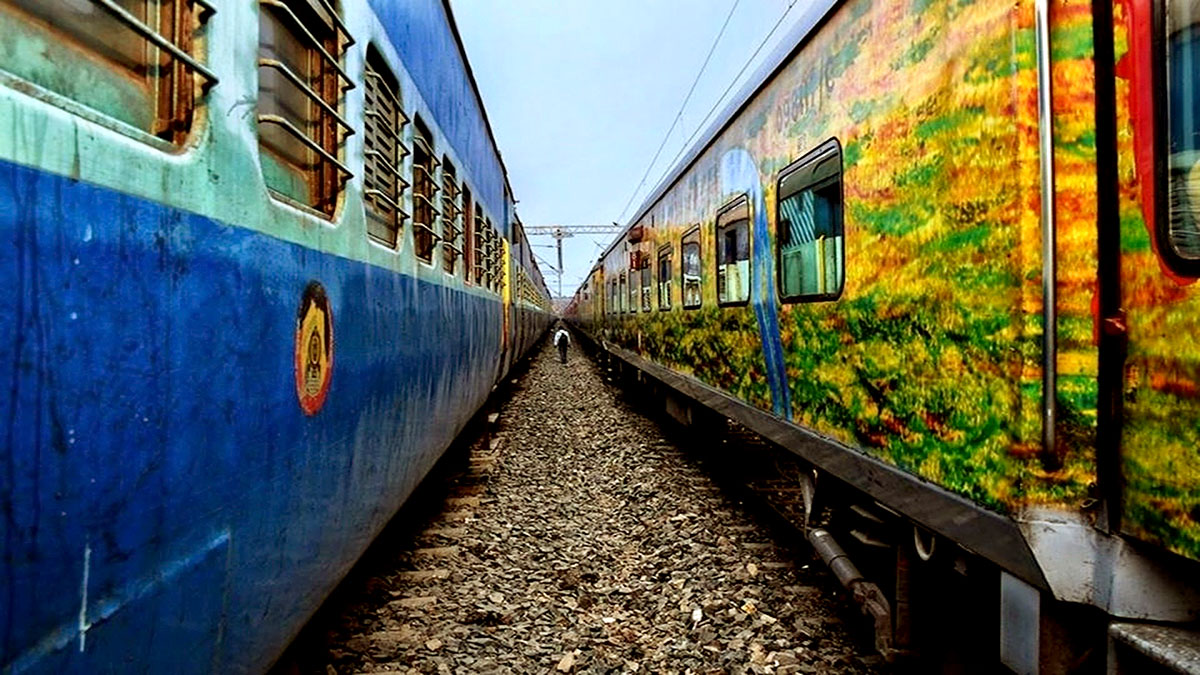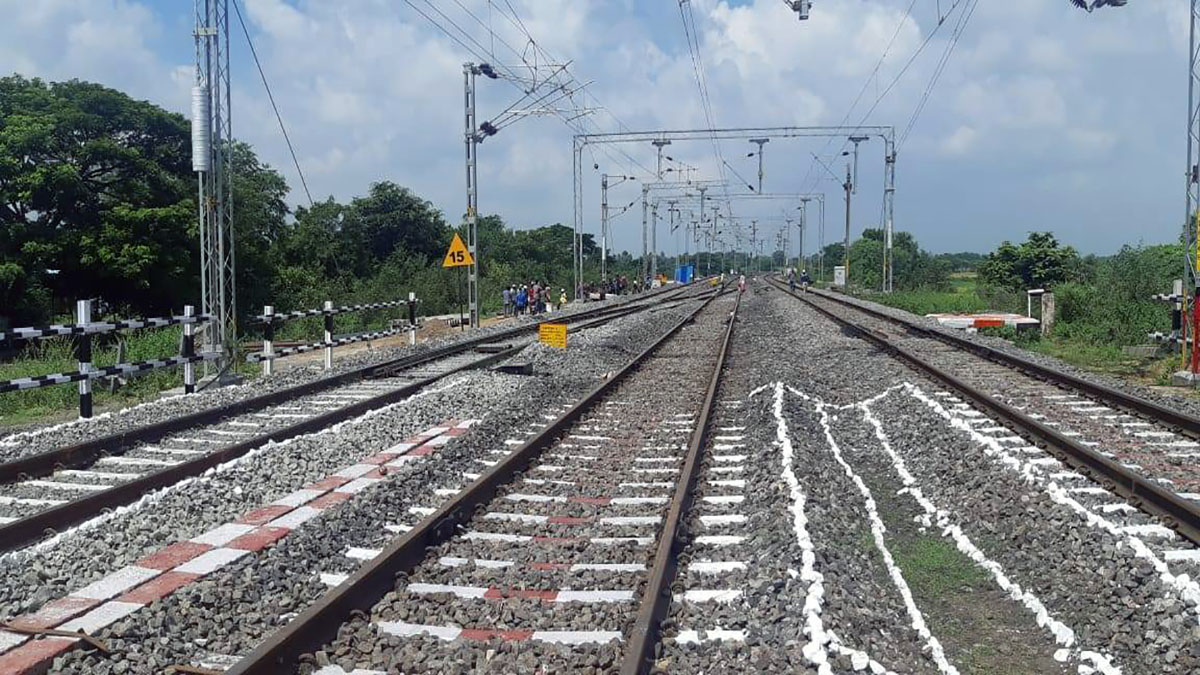

Indian Railways is on the brink of achieving full electrification of its broad-gauge network, with 99.2% of routes already electrified as of November 30, 2025, marking one of the fastest and most extensive rail electrification drives in the world. Out of a total broad-gauge network of about 70,001 route kilometres, 69,427 route kilometres have been electrified, leaving just 574 route kilometres to be completed, according to official data from the Ministry of Railways.
The scale and pace of India’s electrification programme stand out sharply in global comparisons. As per the June 2025 report of the International Union of Railways, the United Kingdom has electrified about 39% of its rail network, Russia 52%, France 60%, Spain 67% and China 82%, while Switzerland remains the only major rail system with 100% electrification. India, having reached over 99%, now ranks among the global front-runners.
Officials attribute this transformation to a mission-mode push undertaken over the past decade. Before 2014, Indian Railways had electrified around 21,800 route kilometres over nearly 60 years. In contrast, between 2014 and 2025 alone, electrification expanded by about 46,900 route kilometres. The pace accelerated dramatically in recent years, with 7,188 route kilometres electrified in 2023–24 and another 2,701 route kilometres added in 2024–25. Data from the railway electrification status report show that the cumulative electrified network rose from just over 22,000 route kilometres in 2014–15 to more than 69,000 route kilometres by November 2025.
The impact of this push is visible across railway zones. Fourteen of the eighteen railway zones, including Central, Northern, Eastern, Western, South Central and East Coast Railways, have already achieved 100% electrification. The remaining zones are close to completion, with North Western and Southern Railways at 98% and Northeast Frontier and South Western Railways at 95% electrification. Overall, zone-wise data confirm that the network-wide electrification level has crossed 99%.
At the state and Union Territory level, 25 states and UTs have achieved full electrification of their existing broad-gauge networks. Large rail states such as Uttar Pradesh, Maharashtra, Gujarat, Bihar, Madhya Pradesh and West Bengal are now entirely electrified. In the Northeast, Arunachal Pradesh, Meghalaya, Nagaland, Tripura and Mizoram have all reached 100% electrification of their existing broad-gauge lines. Among the remaining states, Rajasthan has achieved about 99% electrification, Tamil Nadu 97%, Karnataka 96%, Assam 92% and Goa 91%, with work ongoing on the balance sections.
The government has also aligned future expansion with its electrification goals. All new railway lines and multi-tracking projects are now sanctioned and constructed with electrification built in from the outset. For 2025–26, the Union Budget has earmarked an outlay of ₹6,150 crore specifically for railway electrification, underlining continued policy focus on completing the remaining sections and strengthening electric traction infrastructure.
Beyond operational efficiency, the electrification drive is central to Indian Railways’ climate strategy. According to a NITI Aayog report on freight transport, rail transport emits about 11.5 grams of carbon dioxide per tonne-kilometre, compared to 101 grams for road transport, translating into nearly 89 per cent lower emissions. Railway officials say that near-total electrification, combined with increasing use of renewable energy sources such as solar and wind through strategic power procurement, will significantly reduce the railways’ carbon footprint and support India’s broader climate commitments.
While the final stretch of electrification faces challenges such as forest clearances, difficult terrain, shifting of utilities and limited working seasons in certain regions, officials remain confident that the remaining gaps will be closed soon.