
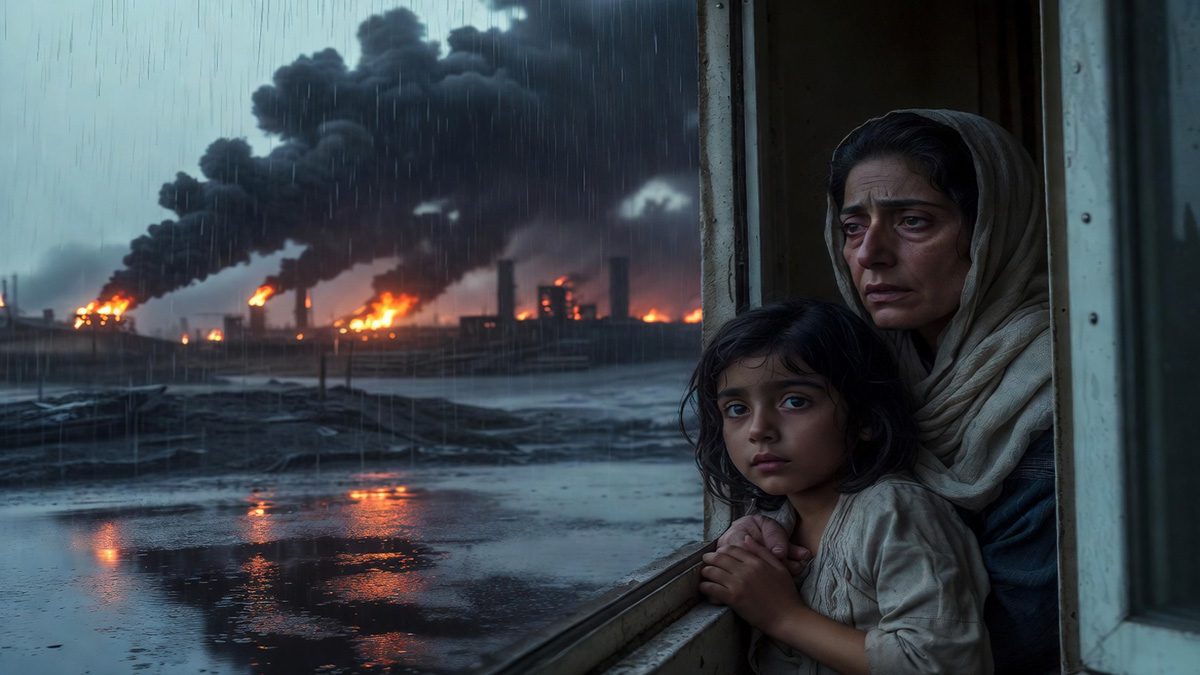

In the cramped alleys of Tehran’s Shahran neighbourhood, 42-year-old Armita keeps her windows sealed even on days when the sun tries to break through. “The rain tasted of oil and left my throat raw,” she told the Irainian State Media. Just days earlier, Israeli strikes had turned nearby fuel depots into blazing infernos. What fell from the sky wasn’t water, it was black, sticky and carried the acrid bite of burning crude. Children coughed through the night. Streets glistened with an unnatural sheen. And across Iran, ordinary families began to understand that this war was not only claiming lives today; it was quietly mortgaging the air their grandchildren will breathe tomorrow.
The strikes that began on 28 February have rapidly expanded beyond military targets. Fuel storage facilities in Shahran, Shahr-e Rey and Aghdasieh now burn unchecked. Thick columns of smoke rise for kilometres, feeding into winds that do not respect borders. The black rain that follows is no mere spectacle, it is a chemical stew of hydrocarbons, sulphur and nitrogen compounds, heavy metals and fine soot particles. When these mix with moisture in the atmosphere, they turn ordinary showers into dilute acid. The oil that leaks from ruptured tanks seeps into soil and aquifers, poisoning farmland and drinking water for years. In a region already parched by decades of warming, this fresh contamination is like pouring salt into an open wound.
What strikes me most, after two decades reporting from conflict zones, is how precisely this war weaponises the climate itself. Oil fires do not simply release smoke; they inject massive doses of black carbon, tiny particles that absorb sunlight and heat the air far more efficiently than carbon dioxide alone. That extra warmth rises, altering wind patterns and rainfall thousands of kilometres away. Here in India we know those patterns intimately. The same black carbon that darkens Tehran’s skies today can settle on Himalayan glaciers tomorrow, speeding their melt and threatening the Ganga-Brahmaputra lifeline that sustains nearly half a billion of us. One major oil-field fire can release as much warming pollution in weeks as entire nations emit in a year. Multiply that across a dozen burning facilities and the arithmetic becomes terrifying.
Add the hidden ledger of modern warfare. Every fighter jet, every aircraft carrier, every supply convoy guzzles jet fuel at a scale that dwarfs civilian aviation. The constant movement of troops and hardware, the rebuilding of destroyed infrastructure with diesel generators and heavy machinery all of it pours greenhouse gases into an atmosphere already strained. These emissions do not vanish when the fighting stops. They linger, trapping heat for decades. The result is a feedback loop we can already trace: warmer temperatures breed more frequent droughts, droughts spark resource conflicts, and those conflicts torch fossil-fuel infrastructure that makes the planet even hotter. Iran 2026 is not an anomaly. It is the cycle accelerating in plain sight.
Look closer at the soil and water beneath the flames. Acid rain leaches toxic metals into the ground, rendering fields unproductive for generations. In a country where agriculture still feeds millions, contaminated irrigation canals mean smaller harvests, higher food prices and greater desperation. Downstream, rivers carrying these pollutants flow toward the Persian Gulf. Should the fighting spread to more Gulf ports and terminals, a real possibility as tensions ripple outward, we risk oil slicks that choke mangroves, kill fish stocks and disrupt the very ocean currents that moderate regional monsoons. The Gulf is not just a shipping lane; it is a climate regulator. Damage it and the weather systems that bring rain to Rajasthan and Gujarat grow more erratic.
For India the consequences are immediate and intimate. Nearly 85% of our crude passes through the Strait of Hormuz. Prices have already climbed sharply; every additional rupee at the pump is money diverted from solar panels on village rooftops or flood defences in coastal towns. While diplomats scramble for alternative supplies, our farmers watch the sky with fresh anxiety. Extra greenhouse gases from this war will nudge monsoon patterns further off-kilter stronger deluges in some years, crippling droughts in others. The poorest, who have contributed least to the climate crisis, will again bear the heaviest burden: flooded homes, failed crops, children struggling to breathe through smoke-tinged air.
There is a deeper, almost poetic cruelty here. This conflict is being fought over the very fossil fuels whose combustion has destabilised the climate in the first place. The oil depots now ablaze were always climate time-bombs either ticking slowly through everyday emissions or detonating suddenly in war. By destroying them violently, we accelerate both the immediate pollution and the long-term warming. It is as if humanity, sensing the house is on fire, has decided to douse the flames with more petrol.
After years of covering disasters, tsunamis, cyclones, melting glaciers, I have come to see that environmental damage from war is uniquely insidious because it is deliberate yet invisible. Missiles have serial numbers; poisoned groundwater does not. Armita in Tehran does not speak of geopolitics or carbon budgets. She speaks of keeping her children indoors, of the metallic taste that lingers after rain. Her worry is the same one I hear from mothers in drought-hit Marathwada or flood-ravaged Assam: what kind of world are we leaving them?
The black rain falling on Iran today is not just a local tragedy. It is a warning written across the sky. Every additional tonne of carbon released in this conflict tightens the noose on an already overheating planet. The long-term toll of acidified soils, melting ice caps, shifting monsoons, unbreathable air, will outlast ceasefires, peace treaties and even the memory of which side struck first.
The only real question left is whether we will keep repeating this deadly pattern until the planet itself forces us to stop or whether we will finally recognise that securing the future requires more than winning wars. It demands ending our addiction to the fuels that make such wars both possible and catastrophic. Until then, the rain will keep falling black somewhere and somewhere a child will ask why the sky has turned against her.