
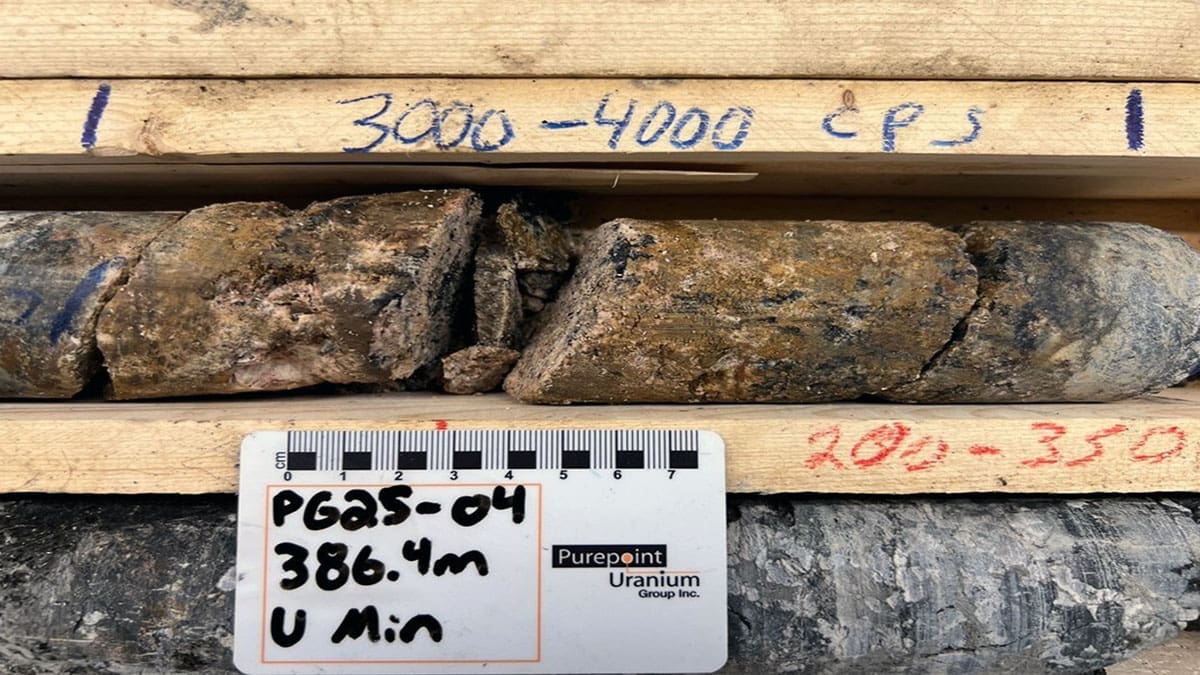

IsoEnergy Ltd and Purepoint Uranium Group Inc have announced a significant uranium discovery from the inaugural drilling campaign at their jointly held Dorado project in Saskatchewan’s Athabasca Basin. The 50/50 joint venture project has delivered promising early results from drilling at the Q48 target, with uranium mineralisation confirmed in two drill holes. The initial drill program is being led by Purepoint as the operator.
Drilling at the Q48 target, situated in the southern region of the project area, intersected uranium-bearing structures within strongly altered basement rocks, a key indicator of an active uranium-bearing hydrothermal system. Two drillholes, PG25-04 and PG25-05, encountered a steeply dipping, north-south trending mineralised structure at depths of 60 and 20 metres below the unconformity, respectively. Downhole gamma probe readings recorded high levels of radioactivity, with PG25-04 averaging 11,050 counts per second (cps) over 3.7 metres and peaking at 74,800 cps, while PG25-05 showed an average of 27,750 cps over 2.3 metres with a maximum of 79,800 cps. The mineralisation is hosted in intensely clay-altered granitic gneiss and pegmatites rock types commonly associated with significant uranium deposits in the region.
The Q48 target was initially identified as a high-priority area based on historical drilling data that revealed structurally disrupted and altered basement rocks exhibiting weak radioactivity. IsoEnergy’s 2022 geological and geophysical analysis further confirmed the area’s potential by identifying brittle faults, shearing, and alteration along a conductive trend. These characteristics strongly suggested the presence of a uranium-bearing hydrothermal system. The current exploration program builds upon this earlier work, aiming to systematically test and follow up along the Q48 conductive corridor.
Drillhole PG25-04 was collared with a dip of -60 degrees and encountered Athabasca sandstone down to 321 metres, followed by clay-altered granitic rocks to 393 metres, and then garnet-rich pelitic gneiss with local graphite and pyrite to a final depth of 489 metres. A central mineralised zone featuring reddish-brown altered radioactive gouge seams within chloritized pegmatite returned high gamma readings, including a notable average of 64,220 cps over a 0.4-metre section. Hole PG25-05, drilled at the same azimuth, intersected the structure approximately 40 metres up-dip from PG25-04. It passed through similar lithologies and encountered the radioactive zone within a sheared and brecciated granitic gneiss, yielding an average of 75,660 cps over a 0.4-metre interval.
A third drillhole is currently underway to further trace the mineralised structure along the Q48 corridor to the northeast. The ongoing program plans to complete approximately 5,400 metres of drilling across 18 holes in 2025, expanding the understanding of this emerging zone.
Chris Frostad, President and CEO of Purepoint, expressed optimism about the initial findings, stating that the early results suggest the team is on the path to a significant discovery. He emphasised the strength of the exploration strategy and the quality of the Q48 target. Philip Williams, CEO and Director of IsoEnergy, also highlighted the success of the partnership, noting that the joint venture was established to focus exploration in areas with high discovery potential. He added that the results reinforce the merits of a focused and well-funded approach, with Dorado now positioned for continued exploration success.