
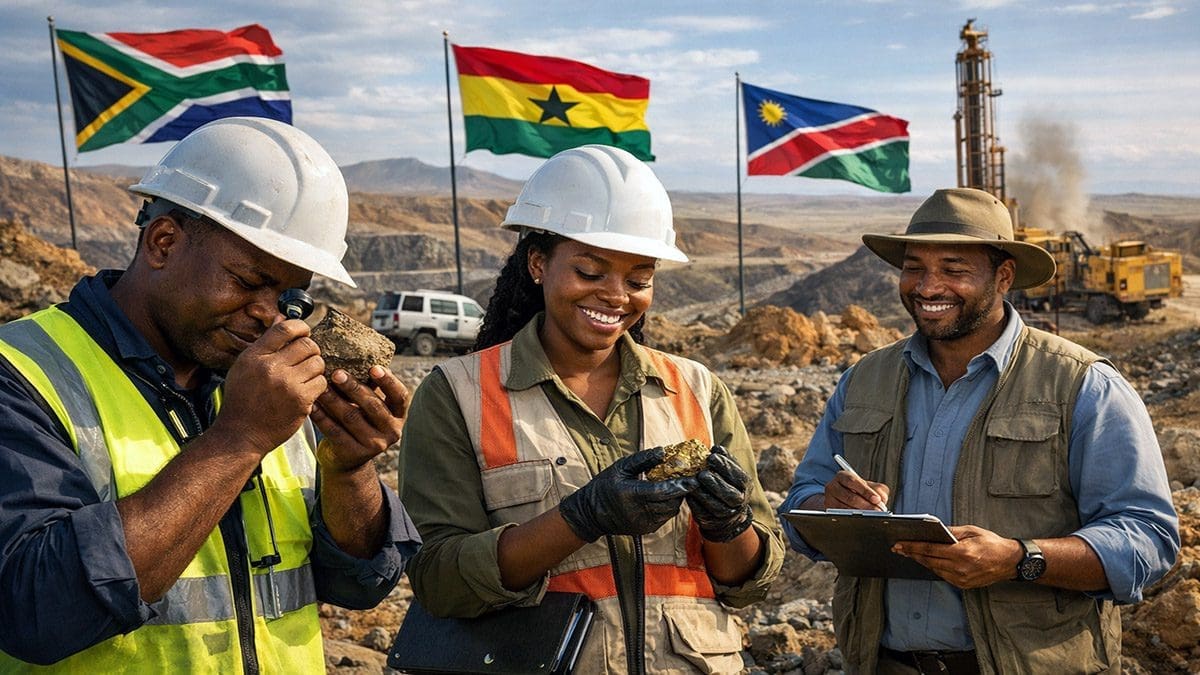

Africa is witnessing a powerful surge in greenfield exploration as countries across the continent accelerate efforts to secure mineral resources critical to the global economy. Rising demand for minerals expected to quadruple by 2040, alongside record-high prices for gold and other commodities, is driving governments and investors to expand exploration pipelines and strengthen Africa’s position in the global mining supply chain.
Recent data highlights the scale of this momentum. South Africa alone awarded 358 new exploration licenses last year, while Ghana is advancing more than 90 projects and Namibia has received over 800 new applications. This wave of activity underscores a broader continental push to unlock untapped reserves, support industrial growth, create jobs and enable downstream economic diversification.
In South Africa, the government is intensifying efforts to maintain its global leadership in platinum group metals, chrome and manganese, while revitalizing gold and iron ore sectors. In 2025, the country issued 358 prospecting rights and 32 mining rights, marking a significant step toward boosting long-term production. To further stimulate exploration, authorities have committed R2 billion to support junior mining companies and are working toward mobilizing R2 trillion in investment in the critical minerals sector. Officials also estimate that the country holds around R40 trillion worth of untapped iron ore resources.
Ghana continues to reinforce its position as Africa’s leading gold producer while expanding into critical minerals. With over 90 active exploration projects, the country has attracted more than $20 billion in mining and exploration investments over the past two years. Speaking earlier this year, Minister for Lands and Natural Resources Emmanuel Armah-Kofi Buah highlighted Ghana’s diverse mineral base, including bauxite, manganese, iron ore, cobalt and nickel, noting that further discoveries will play a key role in supporting the global energy transition.
Meanwhile, Namibia is rapidly advancing reforms to unlock its mining potential, particularly in uranium and diamonds. The country currently holds 588 Exclusive Prospecting Licenses and is processing more than 800 new applications. To streamline approvals and reduce backlogs, Namibia has introduced digital licensing platforms aimed at improving regulatory efficiency. With over 600 environmental approvals pending, the government is positioning the country to attract increased exploration investment and accelerate new discoveries.
Beyond these key markets, other African nations are also ramping up exploration. Zambia is expanding copper exploration with the goal of reaching annual production of 3 million tons by 2031. Guinea, meanwhile, is advancing work around the $20 billion Simandou iron ore project widely regarded as the world’s largest untapped iron ore deposit as part of its long-term economic diversification strategy.
This surge in exploration activity sets the stage for African Mining Week 2026, scheduled to take place from October 14 to 16 in Cape Town. The event is expected to bring together industry leaders, investors and policymakers to showcase emerging projects, discuss investment opportunities and outline strategies to unlock Africa’s vast and largely untapped mineral wealth.

