
The eruption of direct military confrontation between the United States, Israel and Iran on February 28, 2026 has pushed global energy security into one of its most fragile moments since the shocks of the early 2000s. Joint American and Israeli strikes on Iranian targets, including locations in Tehran, have transformed months of diplomatic stalemate into active combat, immediately reverberating through oil, shipping and insurance markets worldwide. For energy-importing nations, particularly across Asia, the conflict has turned a long-acknowledged geopolitical risk into a lived economic reality, measured daily in higher prices, rising volatility and growing anxiety over supply continuity.
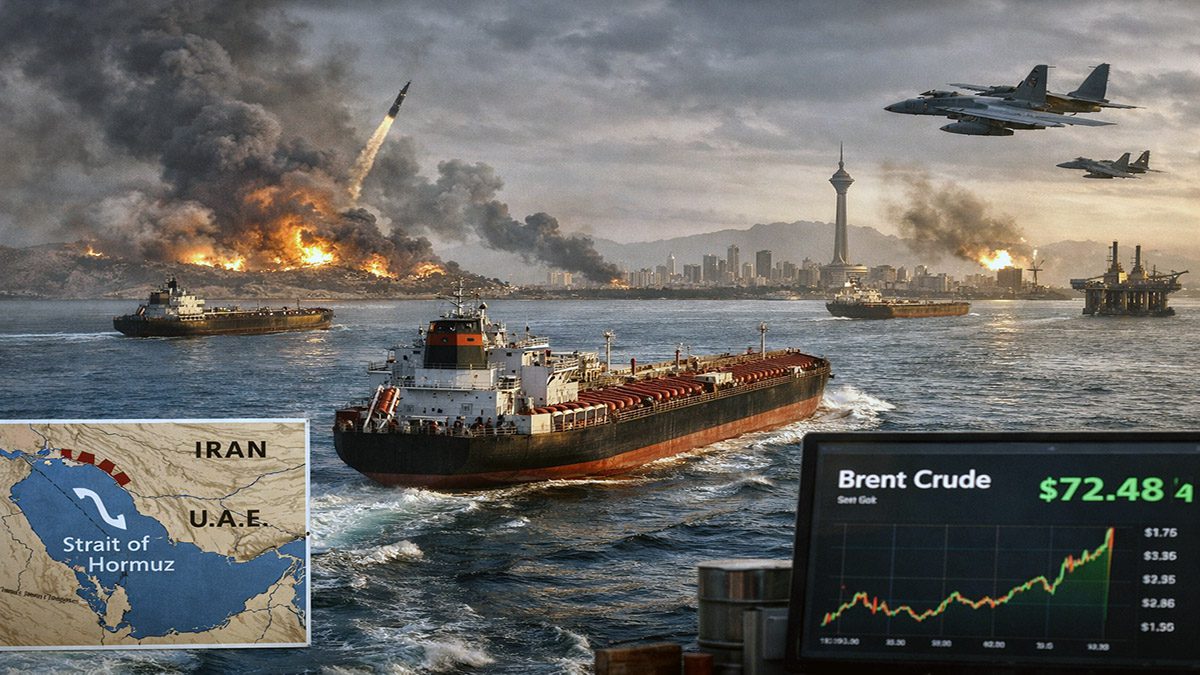
Within hours of the first confirmed strikes, oil markets reacted with the speed that only fear can generate. Brent crude surged to around 72.48 dollars per barrel (at the time of publishing), while West Texas Intermediate climbed close to 67 dollars, marking a sharp 2-3% single-day gain. These moves were not driven by any immediate loss of barrels but by the re-pricing of risk. Traders rapidly embedded a geopolitical premium reflecting the possibility that Iran could retaliate against energy infrastructure or shipping routes in the Persian Gulf. The focus of that fear remains the Strait of Hormuz, a narrow maritime corridor through which roughly twenty million barrels of oil per day and substantial volumes of liquefied natural gas pass. Any threat to this artery has outsized consequences for the global economy.
The escalation did not come without warning. Nuclear negotiations with Tehran had been faltering for months, and markets had grown accustomed to periodic rhetorical flare-ups. Yet the shift from diplomatic deadlock to coordinated air and missile strikes marks a decisive break. Iranian retaliation, including missile launches and heightened air-defence alerts across the region, has reinforced perceptions that this is not a limited or symbolic exchange but a conflict with the potential to widen. Energy futures have responded accordingly, with intraday price swings becoming more pronounced as traders react to every headline from the Gulf.
Beyond benchmark prices, the conflict’s most immediate economic impact is visible in the plumbing of global trade. Tanker freight rates for Middle Eastern crude have climbed to six-year highs as shipping companies confront soaring war-risk insurance premiums. Each voyage through the Gulf now carries additional costs running into thousands of dollars, costs that are ultimately passed on to refiners and consumers. Some operators have already begun rerouting vessels or delaying departures, unwilling to expose crews and cargoes to missile or drone threats. Even temporary diversions tighten effective supply by reducing the number of ships available to move oil, amplifying price pressures beyond the crude market itself.
For Asia, which absorbs the bulk of Persian Gulf exports, these developments translate quickly into higher import bills. Major buyers such as China, India, Japan and South Korea rely heavily on Gulf supplies and all face the same structural vulnerability to Hormuz disruptions. In India’s case, nearly half of crude imports transit the strait, and more than forty per cent of total supply comes from West Asian producers. With overall crude import dependence exceeding 90%, even modest price increases ripple rapidly through the economy. Analysts estimate that a sustained $ 5-6 rise in crude prices can add billions of dollars annually to India’s energy import bill, straining the current account and complicating fiscal planning.
These pressures are already filtering down to households and industry. Higher crude prices feed into more expensive petrol, diesel and aviation fuel, pushing up transportation costs across the board. Utilities dependent on fuel oil or gas face rising input prices, which eventually show up as higher electricity tariffs. For manufacturers operating on thin margins, energy inflation erodes competitiveness, while consumers confront rising costs of everyday goods as logistics expenses climb. The conflict, though geographically distant for many, thus manifests as a tangible squeeze on living standards.
The situation is further complicated by the behaviour of buyers and sellers attempting to anticipate the next move. Asian refiners have begun front-loading purchases where possible, seeking to build inventories against potential short-term shortages. This rush to secure barrels can itself tighten markets, reinforcing price increases. At the same time, alternative supply options carry their own constraints. Crude from the Americas or other distant producers involves longer shipping times, higher freight costs and in some cases, quality mismatches that require refinery adjustments. Russian crude, which had offered some diversification in recent years, is now subject to renewed uncertainty amid secondary sanctions pressures, limiting its reliability as a fallback option.
Each new report of naval manoeuvres near the Strait of Hormuz or additional sanctions on Iranian export vessels adds another layer of volatility. Recent military drills that imposed temporary restrictions on navigation have already demonstrated how even partial interruptions can spike freight rates and delay deliveries. Liquefied natural gas cargoes, critical for power generation in parts of Asia and Europe, are equally exposed. While major Gulf producers hold some spare production capacity that can cushion temporary losses, this buffer is finite and offers little protection if transit routes themselves are compromised.
The longer-term implications of the conflict are even more sobering. The Strait of Hormuz is the world’s most critical energy chokepoint, handling nearly a quarter of all seaborne oil trade, and there is no viable full bypass in the near term. Repeated crises in this narrow waterway threaten to normalise higher baseline energy prices as markets demand a permanent risk premium. In more severe scenarios, analysts warn that partial disruptions lasting weeks could remove five to ten million barrels per day from global supply, pushing Brent prices toward ninety or even one hundred dollars per barrel. A full closure, however unlikely, could eliminate up to twenty million barrels daily, with prices potentially surging beyond 120 or 140 dollars and inflicting prolonged economic damage.
Such sustained elevation would reshape investment decisions across the energy sector. Higher price volatility and geopolitical risk raise borrowing costs for projects in unstable regions and deter long-term investment in conventional infrastructure. At the same time, the very insecurity that undermines oil and gas supply is accelerating the shift toward renewables and alternative energy sources. Governments and investors increasingly view solar, wind, nuclear and green hydrogen not just as climate solutions but as strategic assets that reduce exposure to geopolitical chokepoints.
India’s predicament illustrates the difficult balancing act facing import-dependent developing economies. Strategic petroleum reserves cover roughly seventy-four days of net imports, offering only limited insulation against prolonged disruptions. Policymakers in New Delhi are intensifying diplomatic engagement with alternative suppliers while accelerating domestic renewable programmes, including large-scale solar and emerging green hydrogen initiatives. Yet these measures cannot fully offset the immediate risks posed by Hormuz instability. Building pipelines, securing long-term contracts with non-OPEC producers or expanding strategic storage requires time and capital, both of which are constrained by rising energy costs today.
The broader macroeconomic consequences of a prolonged conflict are significant. Modelling suggests that sustained high energy prices could shave several tenths of a percentage point off global GDP growth, while inflating borrowing needs for both producers and consumers. Gulf exporters themselves face a paradoxical risk: retaliation or escalation could strand their own production capacity even as they attempt to raise output to stabilise markets. For consumers worldwide, higher fuel and manufacturing costs cascade into retail inflation, eroding purchasing power and complicating monetary policy.
What emerges from this crisis is a sharper understanding of energy security as a multidimensional challenge. It is no longer sufficient to count barrels or cubic metres; resilience against geopolitical shocks has become equally important. Strategic stockpiling, diversified supply chains, flexible infrastructure and multilateral emergency-sharing mechanisms are moving from policy rhetoric to necessity. Yet cooperation is harder to achieve in an atmosphere of conflict and sanctions, particularly when trust between major powers is fraying.
For India and much of the global south, the stakes are especially high. These economies must navigate a narrow path between absorbing escalating import costs in the present and financing the substantial investments required for a cleaner, more secure energy future. The February 28 escalation has made clear that geography and geopolitics can still override market logic, transforming abstract risk into daily economic strain. As the war unfolds, policymakers and markets alike are being forced to confront a new reality in which energy security, national security and economic stability are inseparably linked, and where decisions taken now will shape the contours of global energy policy for years to come.