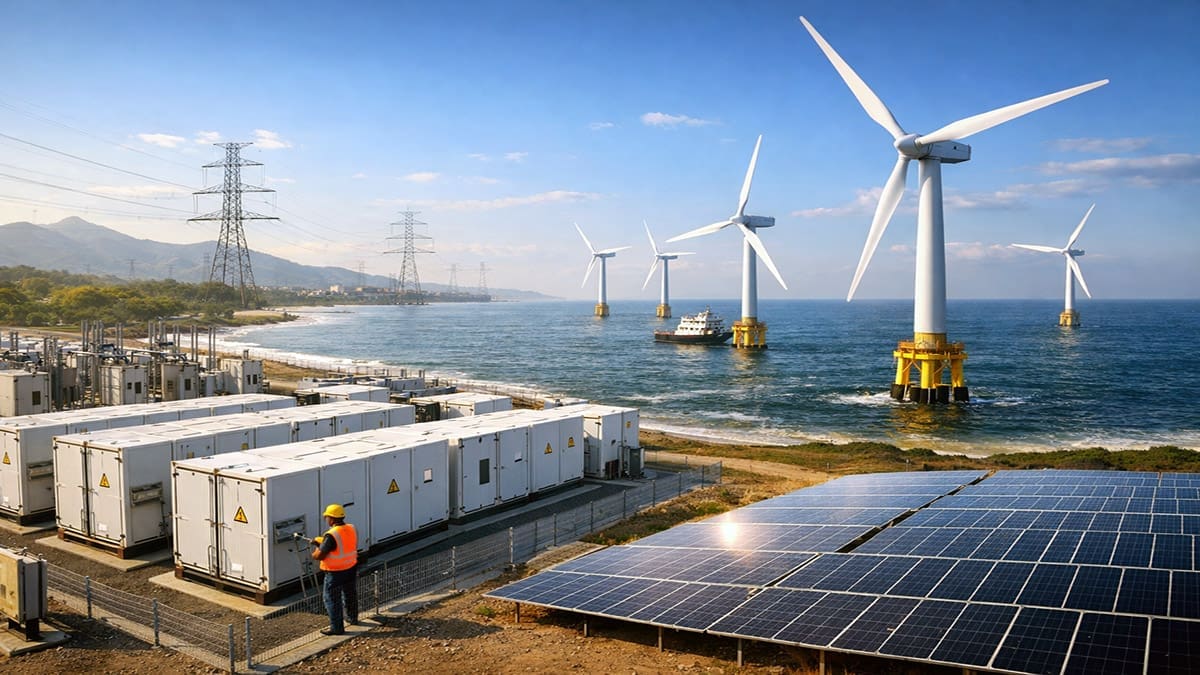

As India accelerates toward its ambitious climate goals, the economic viability of new technologies remains the central challenge. The Economic Survey 2025-26 underscores a pivotal shift in the government’s approach: moving beyond simple subsidies to strategic financial interventions designed to de-risk critical infrastructure. At the heart of this strategy lies Viability Gap Funding (VGF), a mechanism that is quietly reshaping the economics of power, energy storage, and renewable integration.
The Survey identifies the VGF scheme as a critical lever for projects that are economically desirable but commercially unviable. By providing upfront grant support, the government is effectively lowering the cost of capital for private developers, enabling them to invest in high-risk, high-reward sectors that are essential for India’s energy security.
The most significant deployment of VGF is visible in the battery storage sector. As the share of renewable energy in the grid rises reaching nearly 52% of installed capacity by December 2025, the need for grid-scale storage to manage intermittency has become urgent. The Central Electricity Authority (CEA) estimates that India will require 336 gigawatt-hours (GWh) of energy storage capacity by 2029–30.
To meet this colossal demand, the government has launched two specific VGF schemes supporting approximately 43 GWh of Battery Energy Storage Systems (BESS). These schemes are designed to bridge the cost differential between current battery prices and the price at which distribution companies (DISCOMs) can afford to buy power. By absorbing a portion of the capital cost, the VGF ensures that the levelized cost of storage remains competitive, making round-the-clock renewable energy a reality.
The impact is already visible on the ground. The Survey highlights a landmark project: a 180MW/360MWh utility-scale standalone BESS in Gujarat, supported by the International Finance Corporation (IFC). This project, described as first-of-a-kind, utilizes concessional support to de-risk the investment, setting a “scale and technology standard for future deployments”. This is a direct application of the principles underpinning VGF, using public or concessional capital to crowd-in private investment for technologies that are not yet fully mature.
Beyond batteries, VGF is also playing a crucial role in unlocking the potential of offshore wind energy. While India has the fourth-largest onshore wind capacity globally, its vast coastline remains largely untapped due to the high costs associated with offshore turbines.
The Survey explicitly mentions ‘Viability Gap Funding for Off-shore Wind energy projects’ as a key enabler in its clean energy roadmap. Offshore wind projects are capital-intensive and technologically complex, often costing significantly more than their onshore counterparts. The VGF support is intended to bring the tariff of offshore wind power closer to onshore levels, making it attractive for DISCOMs to procure. This strategic intervention is essential for diversifying India’s renewable portfolio beyond solar and onshore wind, providing a more balanced and reliable green energy mix.
The broader philosophy behind these VGF initiatives is detailed in the Survey’s discussion on infrastructure financing. The VGF Scheme provides financial assistance up to 40% of capital expenditure (Capex)for economic sector projects. As of December 2025, 72 projects have been approved under this scheme, with a total sanctioned VGF of ₹7,941 crore.
This mechanism is particularly vital for the energy sector, where projects often have long gestation periods and revenue streams can be uncertain. By providing a capital grant during the construction phase, VGF reduces the debt burden on the project, improving its Debt Service Coverage Ratio (DSCR) and making it bankable for lenders. The Survey notes that ₹6,314.86 crore has already been disbursed, signalling efficient execution.
While VGF addresses the capital cost, the Survey highlights that it is part of a larger ecosystem of financial reforms. The RBI’s Project Finance Directions 2025 have unified lending norms, providing regulatory clarity for large-scale energy projects. Simultaneously, the Production Linked Incentive (PLI) scheme complements VGF by supporting the upstream manufacturing of critical components. For instance, the ₹18,100 crore PLI for Advanced Chemistry Cell (ACC) batteries aims to domesticate cell manufacturing, which will eventually lower the cost of BESS projects, reducing the need for VGF in the long term.
Furthermore, the government is leveraging global climate finance to supplement domestic VGF. The Survey discusses the need for blended finance mechanisms, where public funds are used to mobilize private capital. It cites the example of the India-UK CETA and other partnerships that are facilitating access to lower-cost international capital for green projects.
The Economic Survey 2025-26 presents Viability Gap Funding not just as a subsidy, but as a strategic bridge to a self-sustaining green economy. By selectively subsidizing the high initial costs of technologies like battery storage and offshore wind, the government is creating a market where none existed. As these technologies mature and economies of scale kick in, the reliance on VGF is expected to diminish. For now, however, it remains the essential spark plug for India’s energy transition, turning ambitious climate goals into bankable, buildable projects on the ground.