
In the intricate tapestry of India’s industrial landscape, few sectors are as physically demanding and logistics-intensive as the cement industry. As the nation accelerates toward its vision of Viksit Bharat @2047, the physical movement of core commodities has transcended simple transportation to become a strategic element of economic efficiency. The Economic Survey 2025-26 highlights a pivotal transformation in this domain: the operationalisation of Dedicated Freight Corridors (DFCs), which are fundamentally altering the cost and delivery equations for major manufacturing hubs, particularly for high-volume commodities like cement.
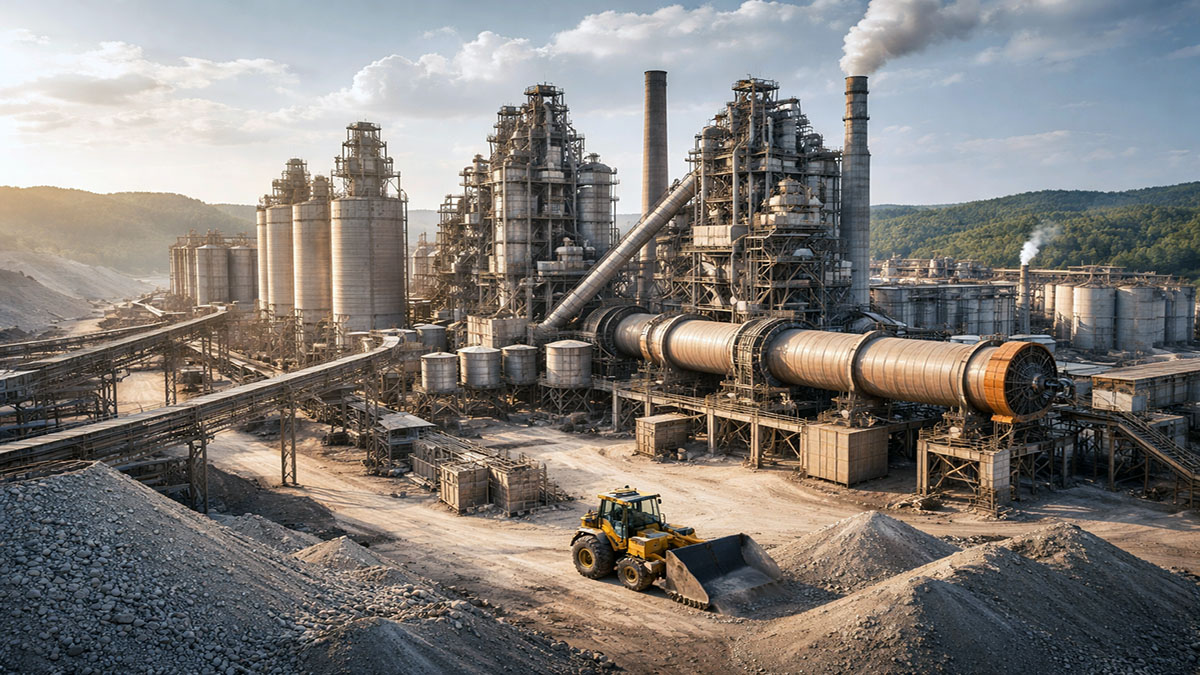
To understand the impact of logistics reforms, one must first appreciate the unique geographic footprint of India’s cement sector. The Survey notes that India is the second-largest cement producer globally, with an installed capacity of approximately 690 million tonnes. However, this capacity is not uniformly distributed. About 85% of the industry is concentrated in just eleven states, including Rajasthan, Andhra Pradesh, Telangana, Karnataka, Madhya Pradesh, Gujarat, Tamil Nadu, Maharashtra, Uttar Pradesh, Chhattisgarh and West Bengal.
This geographical concentration creates a massive logistical challenge: raw materials (limestone, coal) must be transported in and finished products must be distributed out to consumption centres across a vast subcontinent. Consequently, logistics efficiency is not merely an operational detail but a core determinant of competitiveness. The Survey identifies logistics costs as a critical variable, noting that the overall logistics cost for the economy has reduced to 7.97% of GDP in FY24, a gain attributed largely to infrastructure interventions like the DFCs.
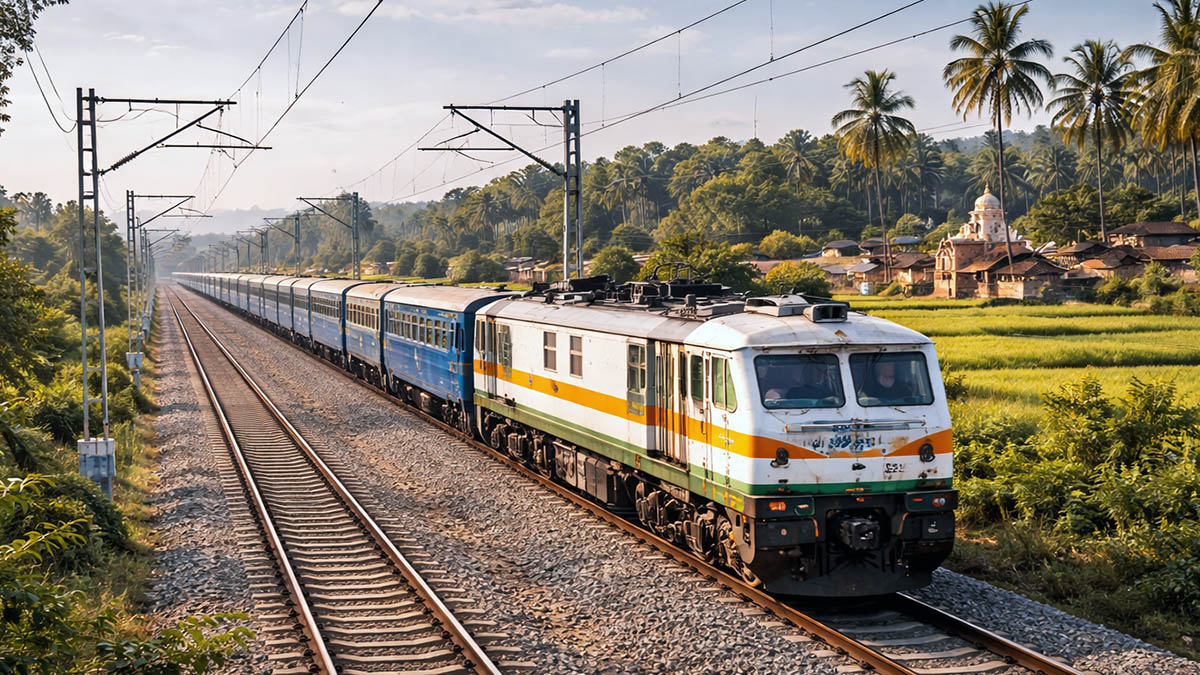
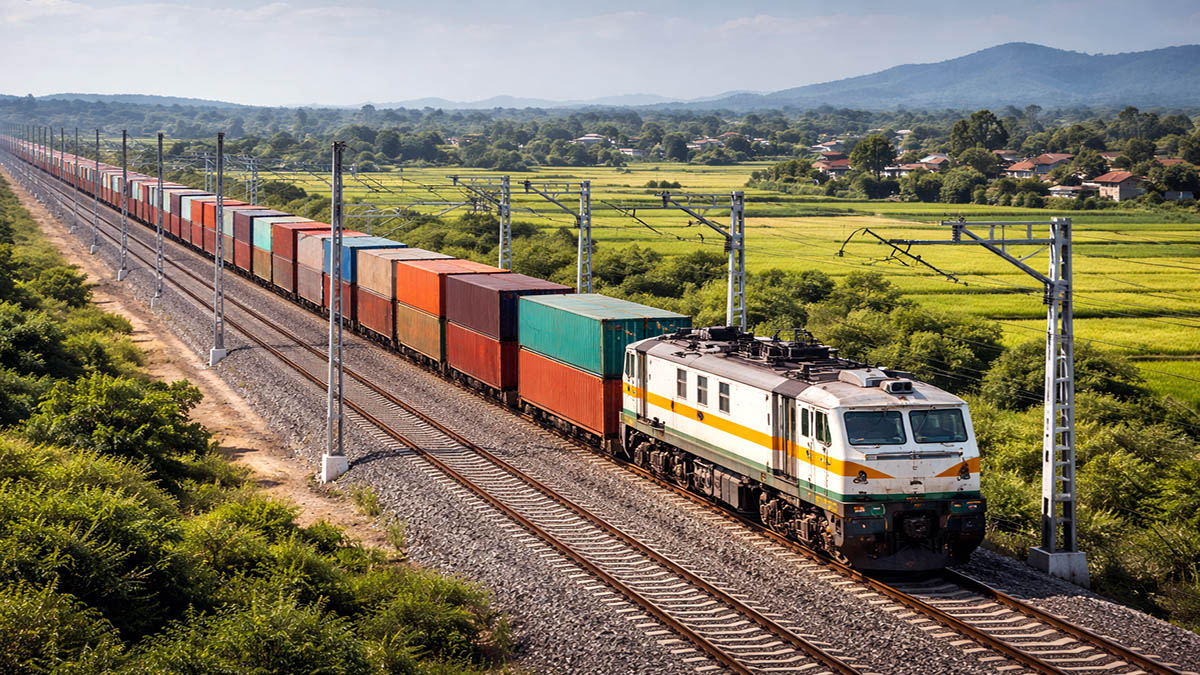
The most significant intervention in rail freight has been the rapid commissioning of the DFCs. The Survey reports that as of October 2025, approximately 2,741 km or 96.4% of the 2,843 km DFC network has been commissioned. This includes the full completion of the Eastern Dedicated Freight Corridor (EDFC), spanning 1,337 km, and the completion of 1,404 km of the 1,506 km Western Dedicated Freight Corridor (WDFC).
For cement hubs located along these alignments particularly in Northern and Western India, this infrastructure creates a segregated channel for cargo, decoupling freight trains from the often-congested passenger rail network. The impact on delivery timelines is structural. By removing freight from shared tracks, the DFCs are ‘significantly reducing freight transit times’, allowing for faster turnaround of rolling stock and more predictable delivery schedules for bulk manufacturers.
Time is a critical currency in the construction sector, where project delays can lead to cost overruns. The DFCs have enhanced the throughput capacity of Indian Railways, enabling it to handle larger volumes at higher speeds. The Survey highlights that in the first nine months of FY26 alone (April-December), Indian Railways achieved a freight loading of 1,215 million tonnes, growing by 3.3%.
Crucially, cement remains a dominant commodity in this basket. During this period, the railways loaded 109 million tonnes of cement, underscoring the sector’s reliance on the rail network. The operationalisation of the DFCs has been instrumental in managing these volumes. By easing congestion on the passenger network, the corridors facilitate a smoother flow of goods from production clusters such as those in Rajasthan and Uttar Pradesh served by the DFCs to end-markets.
Furthermore, the government is not stopping at the current DFCs. The Survey outlines the development of ‘Economic Railway Corridors’ under the PM GatiShakti framework. Specifically, the ‘Energy, Mineral & Cement Corridor’ has been identified as a priority programme. This initiative includes 434 identified projects with an outlay of ₹11.17 lakh crore, aimed at strengthening multimodal connectivity specifically for sectors like cement.
The economic rationale for DFCs extends beyond speed to the critical metric of cost. High logistics costs have historically eroded the margins of domestic manufacturers. The Survey explicitly states that the DFCs are ‘contributing to lowering logistics costs’. For the cement industry, where freight can account for a significant portion of the final price, this is a direct boost to profitability and market reach.
This cost rationalisation is supported by the National Logistics Policy, under which a ‘Sectoral Plan for Efficient Logistics’ has been developed specifically for the cement industry. This plan focuses on digital transparency and multimodal connectivity to drive efficiency gains. By shifting bulk movement from road to the more cost-effective rail network now fortified by DFCs, the industry can optimise its supply chain spend. The Survey notes that rail freight services are generally ‘50% cost-effective’, compared to road transport for long-distance cargo, making the enhanced capacity of the DFCs a vital economic lever.
The impact of these corridors is likely to be uneven but transformative. Hubs in the North and West, serviced by the EDFC and WDFC, are poised to see the most immediate benefits in terms of market access. The Survey notes that the industry faces regional imbalances, such as in the Southern region, where utilisation hovers at 60-65%. The expansion of dedicated rail corridors could potentially allow surplus production from such regions to reach demand centres more efficiently, mitigating localised price volatility.
Looking ahead, the integration of DFCs with last-mile connectivity initiatives is set to further refine delivery timelines. The Survey highlights the “GatiShakti Multimodal Cargo Terminal (GCT)” policy, which aims to seamlessly link rail corridors with industrial hinterlands. Additionally, the push for digital platforms like the Freight Operations Information System (FOIS) ensures that the physical speed of the DFCs is matched by digital efficiency in booking and tracking cargo.
The expansion of the Dedicated Freight Corridors represents a paradigm shift for India’s cement sector. It is moving the industry away from a logistics model defined by constraints and congestion toward one defined by speed, reliability, and cost-efficiency. As detailed in the Economic Survey 2025-26, the near-complete commissioning of the current DFC network, combined with future Economic Railway Corridors, provides the cement industry with the robust logistical backbone required to support India’s massive infrastructure and housing demands. By effectively shrinking the distance between the limestone quarry and the construction site, DFCs are laying a concrete foundation for India’s industrial future.