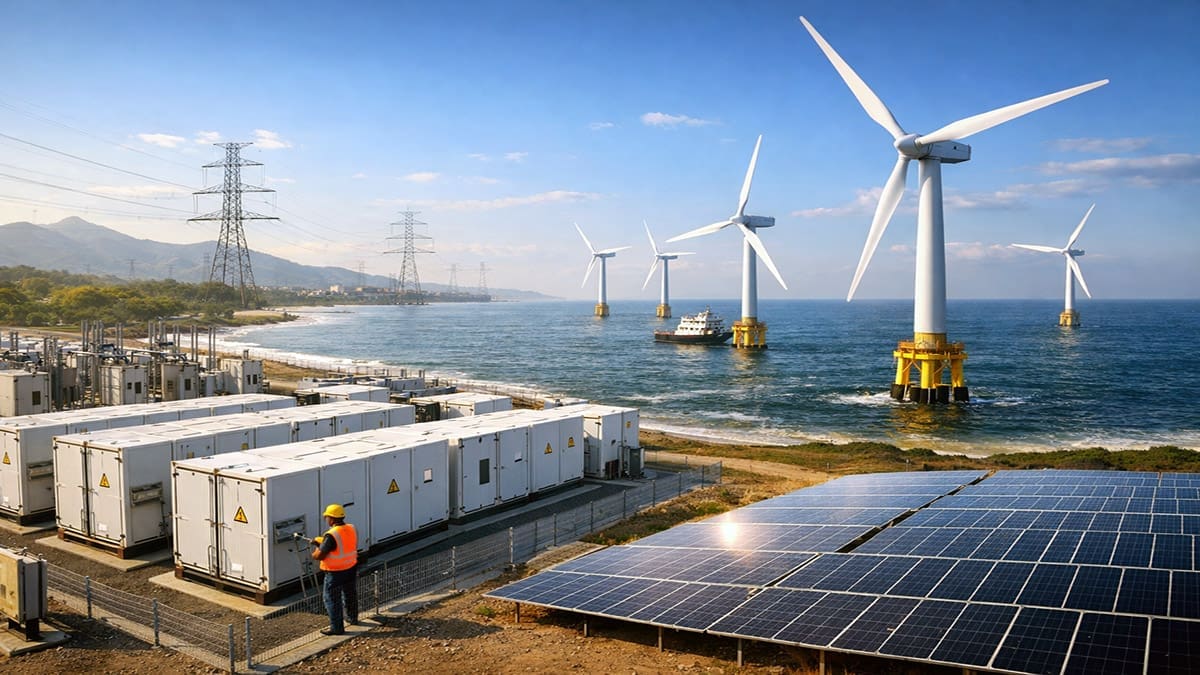
For years, India’s clean energy narrative has been defined by the rapid expansion of solar and wind power. The Economic Survey 2025–26, however, makes it clear that the next phase of the energy transition will be decided not by how much renewable capacity is installed, but by how effectively electricity can be stored, dispatched and stabilised. Battery energy storage systems, once peripheral to energy planning, are now emerging as a central pillar of India’s power sector transformation.
The Survey places battery storage at the heart of a structural shift in India’s energy architecture. As renewable energy moves from marginal supplementation to system-scale deployment, intermittency has become the binding constraint. Solar generation peaks during the day, wind output fluctuates seasonally, and electricity demand increasingly stretches into evening and night-time hours. In this context, battery storage is no longer optional infrastructure; it is system-critical.
Rapid growth driven by grid necessity
India’s battery storage sector is still nascent but expanding rapidly. The Economic Survey notes that grid-scale Battery Energy Storage Systems are now being actively planned and tendered by central and state utilities, marking a decisive break from earlier pilot-driven experimentation. Storage is increasingly being procured as an integrated component of renewable energy projects, transmission planning and peak-load management rather than as a standalone asset.
This shift reflects a growing recognition within policy circles that renewable capacity additions without parallel investments in storage risk undermining grid stability rather than enhancing energy security. As renewable penetration rises, storage capacity must scale in tandem to manage frequency fluctuations, smooth ramping requirements and reduce dependence on fossil fuel-based peaking plants.
The scale of this requirement is substantial. India is projected to need around 336 gigawatt-hours of energy storage capacity by 2029–30, rising to 411 GWh by 2031–32, simply to ensure reliable integration of renewable energy into the grid. These estimates underscore that storage is no longer a niche solution but a system-level necessity.
The Survey links this directly to India’s rising electricity demand, driven by urbanisation, industrial expansion and the rapid growth of digital infrastructure. With per capita power consumption still well below advanced economy levels and demand expected to remain robust, renewable energy without adequate storage risks creating volatility rather than resilience.
Integration with renewables and power markets
One of the most significant insights in the Economic Survey is that battery storage is reshaping how India approaches power markets. Storage enables time-shifting of electricity, allowing excess solar generation to be stored during the day and dispatched during evening peak hours. This has far-reaching implications not only for grid stability, but also for power pricing, contract structures and utility finances.
The Survey highlights that storage can reduce renewable energy curtailment, a persistent challenge in states with high renewable penetration, while lowering the need for expensive fossil fuel-based peaking capacity. Over time, this integration is expected to improve overall system efficiency and reduce costs across the power sector, even though storage projects remain capital-intensive in the near term.
Storage is also emerging as an enabling technology for the next generation of clean energy applications, including electric mobility, green hydrogen production and decentralised energy systems. Without affordable and scalable storage, these sectors risk facing power reliability bottlenecks that could slow adoption and investment.
Cost trajectories and the capital challenge
Despite its strategic importance, the Economic Survey is candid about the sector’s most significant hurdle: cost. Battery storage systems require large upfront capital, and India’s structurally high cost of capital raises financing costs relative to advanced economies. This challenge mirrors the Survey’s broader macroeconomic analysis, which links infrastructure affordability to current account dynamics and dependence on external financing.
At the same time, the Survey points to global learning curves that favour long-term cost reductions. Lithium-ion battery prices have fallen sharply over the past decade, and further declines are expected as manufacturing scales, technologies improve and supply chains mature. India’s policy challenge, therefore, lies in timing and sequencing, deploying sufficient storage to stabilise the grid without undermining affordability for utilities and consumers.
Recognising that costs remain a barrier, the government has begun using targeted fiscal instruments to accelerate deployment. The Economic Survey highlights two Viability Gap Funding schemes launched in March 2024 and June 2025 that together support approximately 43 GWh of battery energy storage capacity. These interventions are intended to de-risk early projects and establish price benchmarks in a market still finding its footing.
Domestic manufacturing and strategic importance
Battery storage is not just an energy issue; it is an industrial one. The Economic Survey states that the batteries within India’s broader effort to strengthen domestic manufacturing and reduce import dependence in strategic technologies. As with solar modules and electrolysers, batteries occupy a critical position in global value chains increasingly shaped by geopolitics.
India’s push to develop domestic battery manufacturing capacity is driven by both economic and strategic considerations. Batteries are central to electric vehicles, grid storage and defence-related applications, and dependence on imported cells and raw materials exposes the economy to supply disruptions and price volatility. The Survey repeatedly flags these risks in the context of a fragmented global order.
At the same time, building a competitive battery manufacturing ecosystem requires scale, technology partnerships and sustained policy support. The Survey implicitly cautions against protectionist shortcuts, arguing instead for competitiveness driven industrial policy that lowers costs and integrates India into global markets.
This manufacturing push is closely linked to deployment. Advisory norms now encourage co-locating storage capacity equivalent to at least ten per cent of installed solar capacity to improve dispatchability and grid stability. At the state level, regulatory innovation is already emerging. Kerala, for instance, has introduced mandates requiring new rooftop solar installations above certain capacities to include battery storage, with thresholds tightening over time.
Landmark projects and global capital
The transition from policy intent to market reality is beginning to take shape through large-scale projects. The Economic Survey points to a landmark investment in FY26, when the International Finance Corporation committed $51.4 million, or roughly ₹460 crore, to support a 180 MW/360 MWh standalone battery energy storage system in Gujarat. Structured with concessional support from the Clean Technology Fund, the project is the largest of its kind in India and is expected to serve as a template for future deployments.
Such investments signal that battery storage is moving beyond experimental pilots to become infrastructure-grade assets capable of attracting global capital, provided regulatory clarity and risk-sharing mechanisms remain credible.
What the sector should look forward to
Looking ahead, the Economic Survey suggests that battery storage in India is poised to move from a supporting role to a system-defining one. The next phase will be marked by larger grid-scale deployments, tighter integration with renewable energy tenders and deeper participation in power markets. Storage is expected to play an expanding role in frequency regulation, peak shaving and ancillary services as renewable penetration rises.
Technological diversification is also likely. While lithium-ion batteries dominate today, alternatives such as sodium-ion, flow batteries and hybrid storage systems are attracting attention for different use cases and storage durations. The Survey does not predict technological winners, but underscores the importance of flexibility and innovation in storage planning.
Perhaps most importantly, battery storage will test India’s institutional readiness. Unlike generation capacity, storage blurs traditional boundaries between generation, transmission and distribution. Regulating, pricing and integrating storage at scale will require regulatory clarity, coordination across agencies and a willingness to adapt legacy power sector frameworks.
System enabler, not a silver bullet
The Economic Survey 2025–26 does not present battery storage as a technological panacea. Instead, it frames it as a system enabler without which India’s clean energy ambitions risk stalling. Storage cannot substitute for grid expansion, transmission investment or demand-side reforms. But without it, renewable energy at scale becomes brittle.
For industry leaders, battery storage represents a long-term opportunity across infrastructure, manufacturing and finance. For policymakers, it is a test of whether India can anticipate system needs rather than react to crises. For analysts, it marks a shift in India’s energy transition from a focus on capacity addition to one centred on system design.
In that sense, battery storage may be the most understated yet consequential component of India’s energy future. It lacks the visibility of solar parks or wind farms, but it will ultimately determine whether clean power is merely generated or reliably delivered.