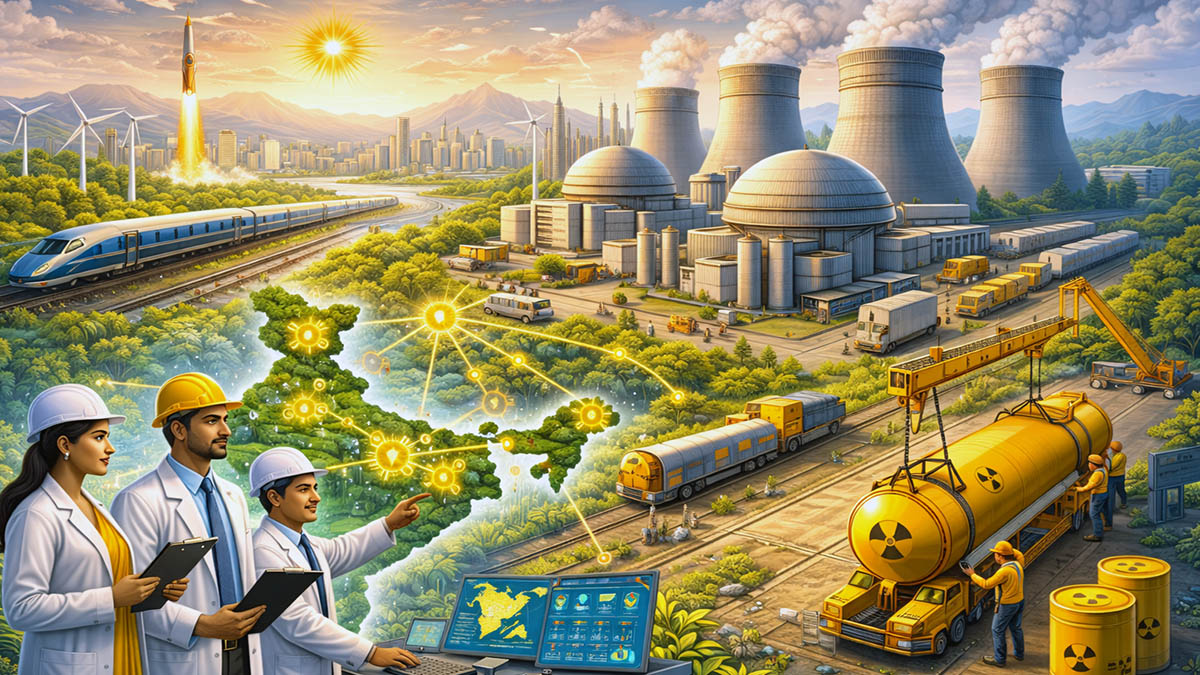

India’s Union Budget 2026–27 lays out an energy and industrial strategy that is notable less for dramatic pivots than for its careful sequencing. Rather than framing the energy transition as a sharp break from the past, the budget reveals a layered approach. Approach that seeks to graft new, low-carbon technologies onto an energy system still dominated by fossil fuels, while simultaneously strengthening domestic manufacturing and control over critical raw materials. The result is a complex and sometimes contradictory package: ambitious in its support for renewables, storage, mining, steel and nuclear power, yet deeply cautious in its continued financial backing for oil and gas. This balancing act reflects India’s developmental realities, but it also exposes the structural tensions involved in reconciling economic growth, energy access and climate commitments.
Arun Shukla, President & Director, JK Lakshmi Cement, remarked, “The Union Budget remains true to the Government’s Viksit Bharat and 2070 Net Zero vision and sends a clear signal on the direction of India’s growth, combining infrastructure-led development with a sharper focus on sustainability. The emphasis on Carbon Capture and Utilisation reflects an important step towards enabling cleaner industrial growth.”
Renewable energy emerges as the most visibly expanded pillar of the clean transition. The Ministry of New and Renewable Energy receives ₹32,915 crore, firmly positioning renewables as a core component of public investment rather than a peripheral experiment. At the heart of this allocation is the ₹22,000 crore outlay for the PM Surya Ghar Muft Bijli Yojana, which aims to dramatically scale up rooftop solar installations across households. Complementing this is ₹5,000 crore for PM-KUSUM, targeted at solarising agricultural pumps to reduce diesel dependence and relieve pressure on state electricity subsidies. Together, these schemes signal a deliberate move away from an exclusive focus on large, centralised renewable parks toward decentralised and distributed generation. This shift has important social implications: it links climate action with lower electricity bills, improved rural energy reliability and more inclusive participation in the energy transition.
Prashant Mathur, CEO, Saatvik Green Energy, said, “Budget 2026 sends a strong and well-balanced signal for India’s clean-energy manufacturing ecosystem and marks a major step forward for India’s solar manufacturing story. By locking in long-term domestic demand through a record ₹12.21 lakh crore capital expenditure outlay and a nearly 29% increase for the PM Surya Ghar Muft Bijli Yojana, the government has created much-needed visibility for large-scale investments across the solar value chain. The extension of customs duty exemptions for lithium-ion cell manufacturing to battery energy storage systems directly strengthens both energy transition and energy security, while the exemption on critical inputs such as sodium antimonate for solar glass will improve cost competitiveness and accelerate domestic capacity creation in a strategically vital segment.”
Yet the rapid expansion of solar capacity brings with it a new set of technical and institutional challenges. Intermittent generation increases the risk of surplus power during daylight hours and shortfalls during evening peaks. The budget acknowledges this problem through a ₹1,000 crore allocation by the Ministry of Power as viability gap funding for Battery Energy Storage Systems. This is a meaningful policy signal, indicating that grid-scale storage is now seen as essential infrastructure rather than a niche technology. Batteries can smooth renewable variability, reduce reliance on peaking fossil plants and strengthen grid resilience. However, the scale of funding remains modest relative to the pace of renewable deployment. India’s future storage requirements are likely to run into tens of gigawatt-hours, suggesting that current allocations are more symbolic than transformative. Without sustained and substantially larger investments, storage risks becoming a bottleneck that constrains renewable efficiency gains.
Electric mobility, while not highlighted through a prominent consumer incentive in these allocations, is indirectly supported through the broader energy and industrial ecosystem the budget seeks to build. Cleaner electricity from solar, expanded transmission networks and grid storage are all prerequisites for large-scale electrification of transport. More importantly, the budget’s emphasis on upstream industrial capabilities ranging from critical minerals to specialty steel, lays the foundation for domestic electric vehicle manufacturing. This reflects an understanding that electrification is not merely a transport policy issue but part of a deeper industrial transformation. At the same time, the absence of a clearly visible demand-side EV push within these ministry budgets underscores the fragmented nature of India’s policy architecture, where incentives are spread across multiple departments and programmes rather than consolidated into a single, coherent framework.
Mining policy provides perhaps the clearest illustration of strategic foresight within the budget. The Ministry of Mines is allocated ₹3,806 crore, including ₹440 crore for the National Critical Mineral Mission and ₹1,500 crore transferred to the National Mineral Exploration and Development Trust. These resources are aimed at accelerating exploration and development of lithium, cobalt, nickel and rare earth elements, materials that underpin batteries, renewable energy technologies and advanced electronics. The message is clear: the energy transition is not only about power generation but also about securing the material foundations of future industries.
Dr Faruk G Patel, CMD, KP Group, said, “Planned incentives for lithium and nickel processing, including an estimated 15% capital subsidy for new processing plants, will strengthen battery and storage supply chains.”
However, this focus on mineral security also raises difficult questions. Expanded extraction in ecologically sensitive regions and areas with complex land rights could generate environmental degradation and social conflict if not carefully managed. Success will depend as much on governance and safeguards as on geological discovery.
A similar logic of value addition and industrial upgrading underpins the steel sector’s allocations. The Ministry of Steel receives ₹443 crore, with ₹380 crore dedicated to the Production Linked Incentive scheme for specialty steel. High-grade steel is essential for electric vehicles, renewable energy infrastructure and defence manufacturing. By encouraging domestic production of these advanced grades, the government aims to reduce import dependence and strengthen India’s position in global manufacturing chains. Public sector enterprises such as SAIL and NMDC are also making large capital investments to secure raw material supplies and expand capacity. Yet steel remains among the most carbon-intensive industries worldwide.
“The way forward must now focus on rapid technology deployment, bankable demonstration projects and close industry-government collaboration, so that India’s steel value chain can emerge as a globally competitive, low-carbon engine of growth for Viksit Bharat”, said Pranav Bansal, CEO, Bansal Wire Industries.
While the budget supports industrial competitiveness, it offers limited direct backing for low-emission steelmaking technologies such as hydrogen-based direct reduction or carbon capture. This gap suggests that decarbonisation of heavy industry, while acknowledged, has not yet become a central budgetary priority.
Nuclear power continues to occupy a steady, if cautious, role in India’s clean energy strategy. Allocations exceeding ₹24,000 crore for the Department of Atomic Energy support reactor construction, fuel cycle operations and research. Nuclear energy offers continuous baseload generation without combustion emissions, making it a valuable stabilising force in a grid increasingly dominated by variable renewables. However, high capital costs, long construction timelines and persistent public concerns around safety and waste disposal limit the speed at which nuclear capacity can expand. In this budget, nuclear power appears less as a transformative solution and more as a dependable complement to renewables.
KL Bansal, CMD, DEE Development Engineers, said, “The approach to energy transition appears balanced and practical. Clean energy solutions such as biomass and waste-to-energy are being recognised for their ability to address emissions, rural income generation, and energy availability together. When combined with nuclear power as a stable, low-carbon baseload and steel as the backbone of infrastructure development, this creates a more integrated energy and manufacturing framework.”
In contrast, oil and gas remain deeply entrenched in the energy economy. The Ministry of Petroleum and Natural Gas receives ₹30,443 crore, including substantial allocations for LPG subsidies and a ₹17,500 crore one-time compensation to oil marketing companies. Investments in strategic petroleum reserves and domestic exploration continue, while biofuel initiatives receive comparatively modest funding. These choices reflect the political and economic sensitivity of fossil fuel pricing. Cooking gas and transport fuels are central to household budgets and economic activity, and sudden price increases carry significant social risks. Ensuring affordability and supply stability therefore remains a dominant concern, even as cleaner alternatives gradually expand.
Finance Minister Nirmala Sitharaman’s budget speech captured this balancing act by emphasising green growth alongside energy security and industrial competitiveness. This framing encapsulates the philosophy underlying the allocations: advance new technologies without destabilising existing systems. The transition, as envisioned here, is one of gradual substitution rather than rapid disruption.
Taken as a whole, the Union Budget 2026–27 sketches an energy transition that is multi-layered, state-directed and deliberately paced. Renewables, storage, critical minerals, industrial upgrading and nuclear power are all being pursued in parallel. Yet the continued scale of fossil fuel subsidies and exploration spending underscores the resilience of legacy systems. The approach spreads risk by investing across multiple pathways, but it also risks diluting focus. Areas such as large-scale storage, green hydrogen and deep industrial decarbonisation remain relatively small in financial terms compared with established sectors.
Ultimately, the budget represents both progress and prudence. Clean technologies are moving into the mainstream of public spending, and industrial policy is increasingly aligned with energy transition needs. At the same time, fossil fuels continue to receive significant support, reflecting concerns about affordability, reliability and political economy. Whether this balanced strategy succeeds will depend on relative momentum. If renewables, storage, clean industry and electric mobility scale rapidly, the transition will appear well managed. If fossil fuel demand remains dominant, the gradualism embedded in the budget may prove insufficient to meet India’s long-term climate and competitiveness goals.